1968 Mustang Hardtop Is a 1-of-1 Unicorn, Packs Super-Rare Factory Cobra Jet, and Mileage Mystery
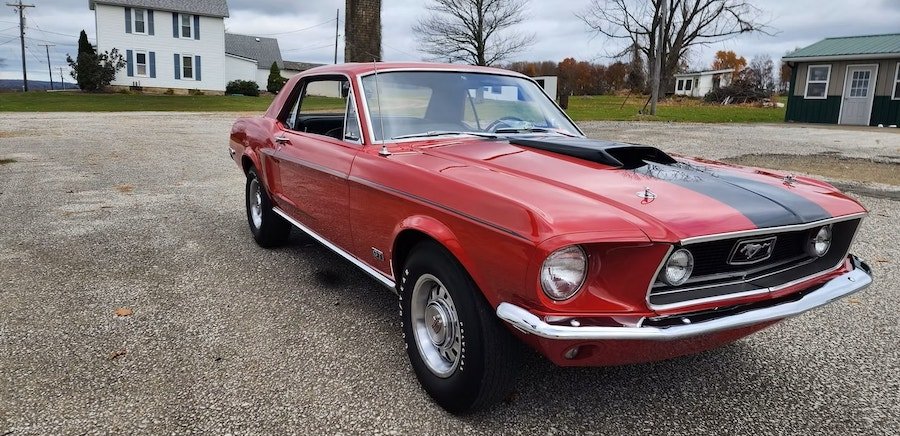
It was, and it has a lot on its name to brag with: Shelby GT350 and GT500, Boss 302, 429, and 351, 428 and 429 Cobra Jet. The former became a very menacing reality mid-way through 1968, in April (the Mustang’s glory month), and here’s one example to prove me right.
In the late sixties, pony cars had matured into full-fledged stallions fighting for supremacy and getting out of no one’s way, no matter how big of an engine those opponents carried, or on what platform they rolled. Chevrolet threw a 396 in the Camaro, Pontiac slammed a 400 in the Firebird, Plymouth stuffed a 383 in the Barracuda (and even a 440), AMC dropped a 390 in the Javelin, all the while Dodge‘s Challenger didn’t bother to exist before 1970.
Ford, on the other hand, was caught slightly off-foot at first, getting the Mustang armed with big-block might with 390 cubic inches fairly late, in ‘67, despite having far better and bigger engines available. However, FoMoCo also had a standing agreement with Shelby American, and the 428 cubic inches in the Police Interceptor from 1967 was plenty go-fast swagger.
And then, Ford decided to throw a curve ball at the very man who led the Blue Oval to Le Mans glory, and threw Shelby’s cobra badge under the bus with a Cobra Jet.
When Ford unleashed the 428 Cobra Jet midway through the 1968 model year, the Dearborn camp finally possessed a lethal weapon to combat rival big-blocks on street and strip alike. The mid-year introduction, historically classified as the 1968 ½ (in line with Ford’s long-standing tradition of “and-a-halves”), achieved instant motorsport folklore by sweeping the 1968 NHRA Winternationals in Pomona.
While the swooping fastback model took nearly all the historical acclaim, the understated two-door hardtop coupe carried that identical thunderous punch beneath its formal notchback roofline.
Muscle motoring enthusiasts who stepped up to buy Ford's brutal R-code engine option overwhelmingly chose the athletic fastback shape, turning the hardtop into an exceptionally scarce oddity. Dearborn assembly lines completed just 221 units of the 1968 1/2 Ford Mustang GT coupe carrying the 428-cubic inch Cobra Jet V8.
By comparison, Ford built 1,044 fastback brethren and a mere 37 convertibles, cementing this hardtop as one of the rarest high-performance production Mustangs to leave the factory.
Ben Shearman, the boss of GTS Classic Motors out of Waterford, Pennsylvania, recently offered a look at an authentic survivor of this low-production breed on the eponymous YouTube channel. Bathed in factory Code T Candyapple Red paint and wearing its mandatory satin black hood stripe, the car stands as an ultimate undercover street brawler. Casual observers at weekend gatherings usually mistake it for a modest small-block daily driver until the burly 7.0-liter FE V8 fires to life.
Shearman is well acquainted with this particular notchback, having owned the pony car several years back before selling it to a family in central Pennsylvania. When those owners decided to travel and part with the coupe after three years, Shearman jumped at the chance to reacquire it. While towing it home with his trailer, an unexpected bearing failure altered the plan, forcing Shearman to drive the car 140 miles (225 km) on Interstate 90 at 65 mph (105 kph).
Unlike touchy concourse showpieces that live solely atop trailers, this genuine R-code performed with impeccable mechanical poise, running cool, tracking straight, and shifting effortlessly through each gear. Naturally, the thirsty big-block demanded three pit stops across that distance – and it wasn’t to change tires, or drivers. That big Holley perched atop an iron intake is the monetary equivalent of plasma cutters, gashing wallets like Japanese sushi masters fileting blue-finned tuna.
Back in Waterford, the GTS Classic Motors team completed a full service, applying heavy-zinc 20W-50 oil and marine-grade grease across the chassis. Not too bad, for a car showing 2,981 miles on the odometer. There is a catch, though, but you’ll have to take it up to Ben himself and inquire about that odometer reading.
Ford officially advertised the 428 Cobra Jet at a modest 335 hp (340 PS) and 440 lb-ft (597 Nm) of torque to outmaneuver escalating insurance rates. The actual dynamometer figure hovered comfortably at 410 hp (406 PS), bolstered by 427-style high-flow cylinder heads, a 735-cfm Holley four-barrel carburetor, and beefier main bearing webs.
Mated to a heavy-duty C6 three-speed automatic transmission and a 3.50:1 Traction-Lok rear axle, the powertrain Ford’s first warning shot in the factory-armed pony horsepower wars.
The Candyapple Red finish recently received extensive multi-stage paint correction, bringing back deep mirror-like gloss across all original sheet metal. Proper GT styled steel wheels feature factory-spec chrome trim rings, center caps, and period-correct F70-14 Goodyear Polyglas bias-ply tires mounted and balanced at Shearman's dealership.
The body structure exhibits clean integrity, retaining solid floor pans, trunk drop-offs, and inner fender aprons, along with the original factory transport tie-down decal affixed beneath the rear bumper.
Inside the passenger compartment, the standard factory black vinyl interior showcases remarkably crisp seating surfaces, original lap safety belts, tinted Carlite glass, and a full center console. An original Philco AM push-button radio sits cleanly inside the dash panel, accompanied by fully functional original gauges, indicators, and courtesy lamps.
The original buyer thoughtfully selected factory power front disc brakes and power steering, giving this heavyweight muscle machine remarkably civilized, compliant, and stress-free road manners that are still up to the job of modern traffic.
Lifting the steel hood reveals an authentic engine bay treated to precise factory details, including correct date-coded spark plug wires, a period Autolite coil, and surviving assembly inspection marks. Along the door data plate and dashboard VIN tag, a framed Elite Marti Report testifies to this Mustang’s authenticity. The Marti documentation confirms that this exact equipment combination, mixing Code T paint with black trim and a console, makes the car a bona fide 1-of-1 build.
While fastback models continually dominate the headlines at major classic car auctions, an authentic 1968 1/2 Mustang GT hardtop coupe offers a far more elusive and stealthier alternative. The car benefits from an older restoration that has settled into sweet running order, completely free of irritating teething troubles or unfinished mechanical quirks.


Verwandte Nachrichten
