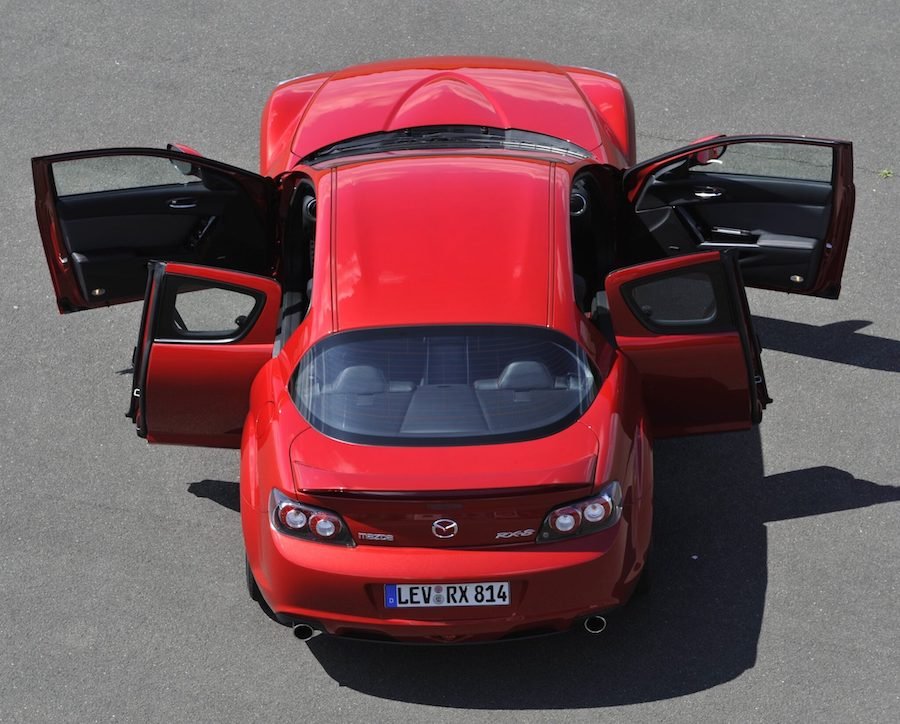
Nestled among them, almost certainly underpriced, you’ll find something altogether more exotic: the Mazda RX-8. Long maligned for its rotary engine and dogged by tales of poor reliability, it has spent two decades as a misunderstood cult car, and few modern classics at this price can match its blend of high-revving performance, usability and engineering individuality.
The catch is that cheap values and a rotary engine that punishes neglect have split the market between worn-out bangers and cherished examples that still deliver. For those prepared to learn its quirks, and to buy carefully (or buy cheaply and budget for an engine rebuild), the RX-8 remains one of the most entertaining bargains on four wheels, but in 2026 the condition of the bodyshell matters almost as much as the health of the engine.
Mazda RX-8 at a glance
| Built | 2003-2012; UK sales 2003-2010 |
| Body styles | Four-door, four-seat coupé with rear-hinged rear doors |
| Engines | 1.3-litre twin-rotor Renesis: 192PS (189bhp) four-port and 231PS (228bhp) six-port |
| Drive | Rear-wheel drive |
| Gearboxes | Five-speed manual (192), six-speed manual (231 and R3), six-speed automatic |
| Most collectable | The 2008-2010 R3, plus the 2006 PZ limited edition |
| Best value | A rust-free 231 with a documented compression test |
| Key checks | Rotary compression test, sill and rear arch corrosion, ignition coils, oil-cooler pipes, cooling system |
| Values (2026) | 192 £1500-6000; 231 £2000-8000; R3 £5000-11,000 |
History of the Mazda RX-8
The RX-8 was Mazda’s replacement for the RX-7, and the latest in a line of rotary-engined cars stretching back to the Cosmo of 1967. Shown as a concept at the 2001 Detroit motor show, it went into production in Hiroshima in February 2003 and arrived in the UK later that year. Rather than a pure sports car, Mazda created a genuine four-seater, with rear-hinged ‘freestyle’ rear doors that open only once the fronts are open and remove the need for a B-pillar. The compact rotary engine sits behind the front axle, giving near-50:50 weight distribution.
At its heart is the 13B-MSP Renesis, a naturally aspirated twin-rotor engine that won the International Engine of the Year award in 2003. UK buyers had a choice of two outputs. The 192PS (189bhp) car has a four-port engine, a five-speed manual gearbox and a 7500rpm red line; the 231PS (228bhp) car adds a six-port engine with a more complex variable intake system, a six-speed manual gearbox and a 9000rpm red line, together with a second oil cooler and uprated suspension.
Of the many special editions, two from 2006 stand out: the Evolve, limited to 500 cars and based on the 231, and the PZ. Developed with Prodrive, the PZ added Bilstein dampers, Eibach springs, a lower ride height, OZ Racing alloy wheels and a twin exhaust; 800 were built, priced at £25,995. Neither is any faster, but both feel more focused and tend to have been well looked after.
When the RX-8 was revised in late 2008, the facelifted car gained restyled bumpers and lights as well as extra body stiffening, revised rear suspension geometry and shorter gearing, while the engine received a much-revised lubrication system, with electrically controlled oil metering pumps, three oil injectors per rotor rather than two and higher oil pressure. The R3, which went on sale in the UK in August 2008 at just under £25,000, added Recaro seats, Bilstein dampers, 19-inch alloy wheels and a bodykit, and is generally regarded as the sweetest-driving RX-8 of all.
The rotary engine’s emissions ultimately counted against it, and the RX-8 was withdrawn from European sale in 2010 after failing to meet Euro 5 standards. Production continued for other markets until June 2012, ending with the Japan-only Spirit R, of which around 2000 were built. Manual versions gained Recaro seats, Bilstein dampers and bronze 19-inch forged wheels, and a few have since been imported to the UK. In all, Mazda built 192,094 RX-8s.
Which Mazda RX-8 should you buy?
There’s no reason to dismiss the 192, whose four-port engine is simpler and lacks the 231’s extra intake hardware. Owners have debated its engine bearings at length, but the condition of an individual engine matters far more than the version. Most buyers will want a 231, though, for the 9000rpm experience that defines the RX-8. If the budget allows, the R3 is the one to have: its revised lubrication system and faster starter motor make it the best-engineered RX-8, although it is by no means immune to wear.
Whichever you choose, check the structure and the engine first, looking for corrosion in the sills and rear arches and insisting on a proper rotary compression test, then turn your attention to the ignition system, the oil-cooler pipes, the cooling system and the catalytic converter.
There’s little point seeking out the lowest-mileage car, as a 90,000-mile example with solid sills, a documented specialist rebuild, strong compression figures, quality ignition parts and stainless oil-cooler pipes is a far better buy than a 35,000-mile car with an ageing original engine, unknown coils and rusty sills. Be wary of any seller who has warmed the engine before you arrive.
Mazda RX-8 common problems and checkpoints
Engine: compression and rebuilds
- Rather than failing suddenly, the Renesis more commonly suffers gradual wear to its apex seals and rotor housings, so that it loses compression and becomes harder to start and down on power. A rotary compression test, using the correct equipment, is close to essential. A conventional piston-engine tester won’t do: the rotary tester takes three readings from each rotor and corrects for cranking speed.
- Mazda’s standard figure is 121psi, with a minimum of 98psi at 250rpm, and there are limits on the variation between chambers and between rotors. Plenty of engines reading in the high 80s and low 90s still start and run well, but a car with figures noticeably below the 98psi minimum should be priced with a rebuild in mind, and one reading below about 85psi deserves very careful consideration. Ask to see the printout, including the cranking speed, rather than being told it ‘passed’.
- Because a worn engine is usually reluctant to restart when hot, arrive with the engine stone cold, drive the car until it is thoroughly warm, switch off for five or ten minutes and restart it. However, many early cars have been fitted with faster aftermarket or R3-type starter motors, which raise the compression generated while cranking and can disguise a tired engine. A faster starter is a worthwhile upgrade, but it is no substitute for a compression test, which matters even more on an R3.
- Plenty of adverts claim that the engine has been rebuilt, so ask who did the work, when, what was replaced and what compression it produced afterwards. Rotor housings are expensive, and cheap fixed-price rebuilds can rely on reusing worn housings and plates. An invoice from a known rotary specialist, ideally with a transferable warranty, is worth far more than a vague claim, and a rebuilt engine should still be compression-tested.
- Engine mounts collapse with age and heat, particularly the one closest to the exhaust manifold. Excessive vibration at idle and a gearlever that moves around point to worn mounts. Overly stiff aftermarket mounts can make the car feel harsh.
Ignition, intake and exhaust
- The ignition system matters more on an RX-8 than on most cars. Weak coils cause a misfire that can be subtle, while unburnt fuel washes oil from the rotor housings, accelerating engine wear, and overheats the catalytic converter. The owners’ club suggests treating the original coils as a 30,000-mile item, while Mazda’s interval for the spark plugs is 37,500 miles or three years. Ask exactly which coils are fitted: cheap counterfeit ‘OE’ coils are common, while revised genuine coils and some quality aftermarket systems last longer.
- A failing catalytic converter is often a consequence of ignition problems, and a partially collapsed one can restrict the exhaust badly enough to strangle the engine at high revs. Listen for rattling from the converter. A car without a catalyst raises MoT questions and has not been made more reliable.
- The 231’s variable intake system uses a series of valves and actuators that open extra ports as the revs rise. If one sticks, the engine develops an obvious flat spot at a particular point in the rev range, so once the engine is fully warm, check that it pulls cleanly all the way to 9000rpm. A ticking at idle can come from play in one of the actuators, and isn’t a problem if performance is unaffected.
Oil and cooling systems
- The rotary engine burns oil by design, injecting it into the rotor housings to lubricate the seals, and around 0.25 litres per 1000 miles is normal. That makes regular top-ups between services vital, and an owner who knows how much oil the car uses, and carries a bottle in the boot, is more reassuring than one who says ‘it never uses any’. Some early cars have been modified to feed separate two-stroke oil to the metering system, or run premixed fuel; these are popular among enthusiasts but are not proof of a healthy engine.
- The steel pipes supplying the front oil coolers are notorious for corroding in salty UK conditions, and a perforated pipe can lose a lot of oil very quickly. Mazda ran a service campaign to replace corroded pipes and fit revised wheelarch liners. Inspect the pipes and their unions behind the front bumper; many cars now have stainless or braided replacements, which are an improvement if neatly fitted. Check the sump for corrosion, too.
- A healthy RX-8 shouldn’t overheat, so don’t accept that ‘they all run hot’. Check the radiator, thermostat, expansion tank and cap and both cooling fans, and make sure the foam seals around the radiator are still in place. The dashboard temperature gauge is heavily damped and won’t move until the engine is already very hot, so an OBD reader showing live coolant temperature is far more useful.
- Unexplained coolant loss is a serious concern, because the engine’s internal water-jacket seals do the job of a head gasket, and combustion gases in the coolant, persistent sweet-smelling steam or a misfire on cold starts can indicate seal failure, which means an engine rebuild.
Transmission and clutch
- The five- and six-speed gearboxes in early cars are generally robust, though worn synchromesh can cause baulking or crunching.
- The R3 uses a different six-speed gearbox, derived from the later MX-5’s, and some early examples suffered synchromesh failures, particularly in third and fourth. Once the car is warm, test rapid changes between those gears.
- On early cars, the spot welds holding the clutch pedal bracket to the bulkhead can crack, causing pedal movement, squeaks and eventually a clutch that won’t fully disengage. Watch the pedal assembly while someone else operates the clutch.
Suspension, steering and brakes
- Front anti-roll bar drop links break relatively often, and the failure isn’t always obvious on a test drive. Check the front lower arms too: early cars were recalled for cracking of the lower ball-joint socket, and a further UK recall covered some 2003-04 cars. Other recalls covered fuel pumps and fuel-line insulation and the driver’s airbag, so check for outstanding work against the VIN.
- If the electric power steering becomes heavy or inconsistent, don’t condemn the rack immediately. A major electrical connector beneath the airbox is vulnerable to water, and corroded contacts or earths can cause erratic assistance.
- Brake calipers can bind on cars that are used infrequently. After a drive, check that no wheel is noticeably hotter than the others.
Bodywork
- Rust is now arguably the most important check, and the rear arches and the rear ends of the sills are the main problem areas: water gets in around the rear arch liner and into the sill, and bubbling paint can hide much worse corrosion inside. Inspect the full length of each sill from underneath, especially just ahead of the rear wheels, and check the front arches and wings too. Structural rust can make a cheap RX-8 uneconomic to save, and engines can be rebuilt more predictably than rotten bodyshells.
- On early cars, the rear door seal could trap moisture where the rear door meets the front; Mazda revised the seal in 2006.
- Alloy wheels on early cars corrode easily, and the rear lamps often mist up or collect water. New seals sometimes cure the problem, but a wet boot should be investigated properly.
- Interior and electrics
- Check the leather seats for wear, particularly the bolsters, and make sure the Bose stereo and climate control work properly.
- On the 231, check that the automatic headlamp levelling works, as the sensors are expensive.
- A failed coolant-level float can trigger a warning even when the level is correct.
Mazda RX-8 values
The sheer number of neglected RX-8s keeps headline values low, although numbers are rapidly declining in the UK. Most cars currently advertised in the UK are priced between £1800 and £5000, with a typical asking price of around £2500, and values have been flat over the past year. Non-runners with failed engines change hands for a few hundred pounds, and cars below £2000 with high mileages and no compression test are best avoided unless you are prepared to rebuild the engine.
A well-kept 231 with a full history, a recent compression test and fresh ignition components is more likely to cost £4000-6000, and that is money well spent, with the very best examples approaching £9000. Exceptionally low-mileage early cars can be priced higher still.
Facelifted cars and R3s carry a premium, with dealers asking £8500-10,000 for R3s with around 50,000 miles. Values are stronger in the US, where good R3s regularly sell for more than $17,000. Japan-only Spirit R models are rarely seen in the UK; one 48,500-mile car was advertised in Tokyo this year at the equivalent of about £12,000-13,000 before shipping and import costs. Whichever version you buy, price in the cost of a compression test and assume that any engine with marginal figures will need a rebuild.
| Fair | Good | Excellent | |
|---|---|---|---|
| 192 (five-speed) | £1500 | £3000 | £6000 |
| 231 (six-speed) | £2000 | £4500 | £8000 |
| R3 | £5000 | £8000 | £11,000 |
Verwandte Nachrichten
