Stunning 1950 Nash Ambassador Is a Rare Low-Mileage Survivor With One Repaint
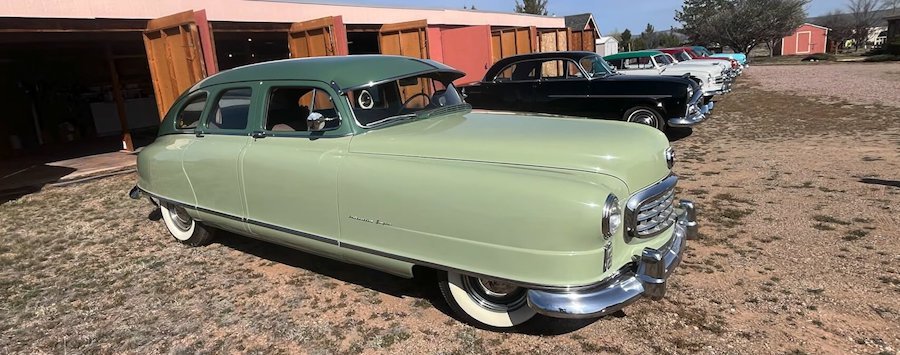
Today's classic car market is packed with vehicles from the Big Three, including cars produced by orphan brands like Plymouth, Oldsmobile, and Mercury. However, we don't see many classics built by independent carmakers that are no longer around. Particularly when talking about survivors in excellent condition.
I'm aware that the interest for orphan brands rarely extends beyond a few Duesenberg, Packard, and Studebaker automobiles, but, to me, that's plain sad. Not only because I'm a fan of lesser-known carmakers, but also because they produced quite a few innovative vehicles back in the day. Which carmakers am I talking about? Well, the list includes the likes of Hudson, Nash, and Kaiser.
I'm going to stick with Nash here because I have a stunning 1950 Ambassador to show you.
Nash Motors was established in 1916 in Kenosha, Wisconsin. It was founded by former General Motors president Charles W. Nash. The company merged with Kelvinator in 1937.
Unable to survive on its own in a market dominated by giants like Ford, GM, and Chrysler, Nash-Kelvinator merged with Hudson in 1954, forming American Motors Corporation (AMC). The Nash brand was phased out in 1957.
Nash pioneered several things in the first half of the 20th century. In 1938, it introduced Weather Eye, the first ventilation system to filter outside air and heat it. In 1954, it debuted the first affordable and fully integrated heating and AC unit. In 1941, Nash introduced the first American mass-produced unibody car.
Finally, Nash anticipated the post-war shift in consumer demands and developed America's first compact car, the Rambler. The vehicle debuted in 1950, about a decade before the major automakers jumped on the bandwagon.
The car you see here is not a Rambler. The Ambassador was a fully-fledged full-size car, the company's flagship model. Nash first used the name in 1927 and introduced a stand-alone model in 1932.
In 1949, Nash gave the Ambassador a massive redesign, the first makeover since resuming production after World War 2. It featured unibody construction, and a highly streamlined body. The "envelope-bodied" style with enclosed front wheels earned it the nickname "the bathtub Nash." But it was also called "the Kenosha Duesenberg" due to its sumptuous ride and luxurious interior.
The Ambassador also pioneered the Uniscope, a pod-mounted instrument cluster placed directly on the steering column. The dash controls were hidden behind a roll top in the center section. The car came with fully reclining front seats that turned the cabin into a full-size bed.
Nash also offered an air mattress, so the Ambassador became a favorite among camping enthusiasts. The story goes that dads would not let their daughters date guys who owned an Ambassador.
The 1950 sedan you see here is owned by Frank Green, and it's one of the finest still in existence. Apart from a repaint it got years ago (in the correct factory colors), this Ambassador is a true survivor. It has an all-original interior, the numbers-matching powerplant, and it's also a low-mileage classic. The odometer reads only 32,000 miles (51,499 km).
The 1950 Ambassador came with a 235-cubic-inch (3.8-liter) inline-six under the hood. It was rated at 112 horsepower and mated with a three-speed manual gearbox. The Ambassador didn't get an automatic until 1951.
The Ambassador was relatively popular in 1950 with around 49,000 examples sold, but it's a rare sight today. That's mainly because most of these cars are rotting away in junkyards and barns. Frank's Ambassador is one of the lucky ones.

