This 1955 Willys Aero Bermuda Is Not a Jeep, Marked the End of an Era
Willys was born in 1908 when John Willys bought the Overland Automotive Division of Standard Wheel Company. From 1912 to 1918, it was the second-largest producer of automobiles in the US after Ford.
The company's early cars are mostly unknown, but the 77 (1933-1936) and Americar (1940-1942) enjoy some degree of popularity thanks to hot-rodders and drag racers. But did you know that Willys designed one of America's first compact cars?
Launched in 1950, the Nash Rambler is widely regarded as the first compact built on this side of the pond. The Big Three didn't join the segment until the end of the decade, but Nash got some competition from other independent carmakers. Kaiser-Frazer jumped on the compact bandwagon with the Henry J that same year, while Hudson began producing the Jet in 1953.
Willys introduced its compact rig in 1952. Called the Aero, it was the brainchild of former Packard engineer Clyde Paton. The Aero shared mechanicals with the civilian Jeep. Early engine options included the 134-cubic-inch (2.2-liter) Hurricane inline-four and both the 161-cubic-inch (2.6-liter) Lightning and Hurricane inline-six. After Willys was purchased by Kaiser in 1953, the Aero became available with the larger 226-cubic-inch (3.7-liter) Super Hurricane straight-six.
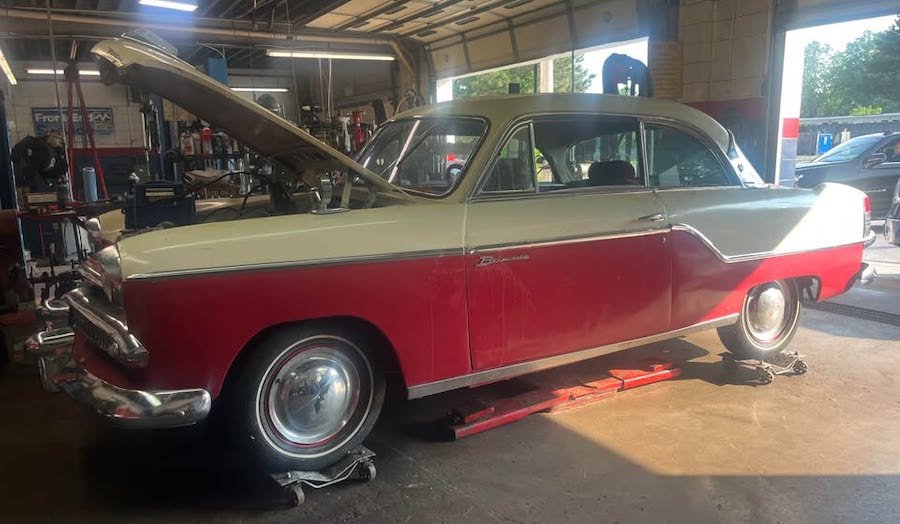
Built in Toledo, the Aero was short-lived. The nameplate was discontinued after the 1955 model year. It was Willys' last US-built automobile (the company produced cars in Brazil from 1959 to 1971). Like most compacts of the era, the Aero was a low-production vehicle. Willys assembled only 91,377 units over four model years. The 1955 Bermuda you see here is one of the last ever made.
A two-door coupe, the Bermuda model was only produced in 1955 alongside the Custom. The final-year Aero is the rarest of the bunch, with only 5,905 units made. Of these, only 2,215 were sold in Bermuda trim. The coupe you see here is one of 2,156 examples equipped with the 226-cubic-inch inline-six. It's probably one of only a few cars in such great condition.
Hailing from Cleveland, Ohio, the Bermuda appears to be an unrestored survivor. It's unclear if the body was repainted at some point, but the interior seems to be original. The same goes for the Super Hurricane engine. Likely kept in storage for decades, the Aero runs and drives, but needs a new master brake cylinder.
Despite its low production number and even lower survival rate, this Willys Aero is quite cheap. The seller wants only $5,500 to let it go, which is far below the average auction price. In 2024, two Aeros changed hands for $8,750 and $10,349 (according to classic.com).
Granted, this Willys is pretty much unknown compared to most US rigs from the mid-1950s, but it's a cool piece of compact car history (especially if you're a fan of orphan brands). Does it deserve more time on the road or should it be parked in a museum?


Nouvelles connexes
