Timeless Charm, Fully Electric Powertrain: Inverted Launches Series Land Rovers Conversion
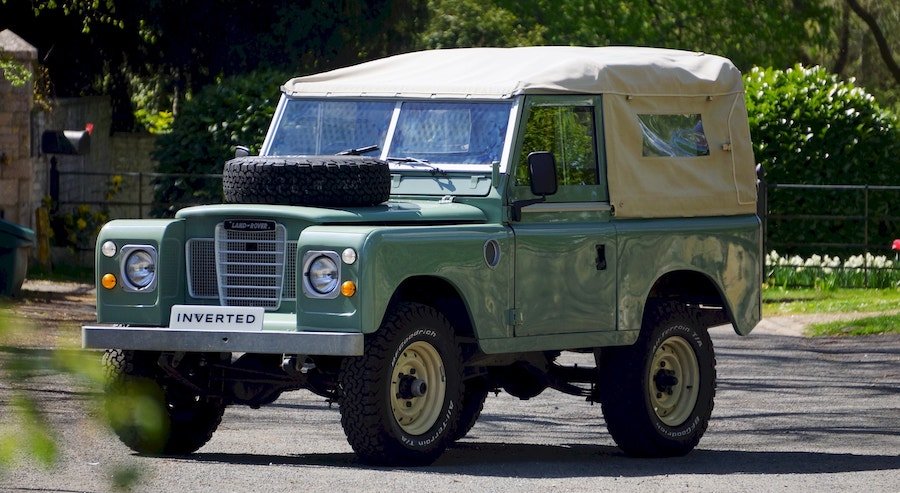
Land Rover wasn't a brand when it started; it merely designated an off-road-capable vehicle made by the Rover Company. However, it was so successful that it outsold the luxury cars produced at the time by the Rover Company. This prompted the carmaker to establish Land Rover as a standalone brand.
The design of the first vehicles was penned by Maurice Wilks, chief designer at the Rover Company, with the prototype based on a Jeep chassis. The production version launched in 1948 as the Land Rover Series I, the first mass-produced civilian 4x4 vehicle. The vehicle was using a proprietary steel box-section ladder chassis and leaf springs, characteristics that defined Land Rovers for decades.
Two of the most striking characteristics of the first models, also known today as the Series Land Rovers, are a consequence of the constraints of that era. The iconic green shades were owed to using military surplus supplies of aircraft cockpit paint. Likewise, aluminum was chosen for the body because steel was rationalized. At the same time, aluminum was abundant and cheap after aircraft production returned to pre-war levels.
The aluminum body of the Series Land Rovers contributed to their famed longevity. It's not hard to find a Land Rover Series I, II, or III that is still in good working order. However, the times have changed, and not everyone is comfortable wrestling with a choke on a cold morning or breathing exhaust gases that enter the cabin, whether there is one or not. That prompted Harry Millington, founder of Inverted, to develop an EV conversion kit for the Series Land Rovers.
The company was founded in 2021 and has extensive experience converting classic Range Rovers and Land Rovers, Toyota Land Cruisers, and other classic vehicles to fully electric. The EV conversion of the Land Rover Series I, II, and III was a natural step. Inverted offers a bespoke experience, with customers invited to work directly with Harry Millington to design and configure the vehicle that suits their style.
The electric motor delivers 160 horsepower and around 900 Nm (664 lb-ft) of torque directly to the transfer box. This means the off-roader keeps its original transfer box, offering high/low range ratios and a locking differential for serious off-road capability. The electric motor propels the Land Rover from zero to 60 mph (97 kph) in just 8 seconds.
The conversion uses a 62-kWh battery pack split between the front and rear to optimize weight distribution and improve traction. Charging it from 20% to 80% takes 38 minutes, and it delivers around 120 miles (193 km) of range when fully charged. The conversion uses a CCS port, providing both AC and DC charging options. AC charging supports up to 6.6 kW via a Type 2 charger, whereas DC fast charging peaks at 60 kW.

Nouvelles connexes
