EV-Swapped Classic BMW 1602 Ditches ICE But Keeps the Four-Speed Manual
It's like seeing people get butt hurt on Twitter over some fandom that doesn't know they exist; it's all just a bit silly. That's why restomod shops like Electric Classic Cars exist, because not everyone has to be a snob.
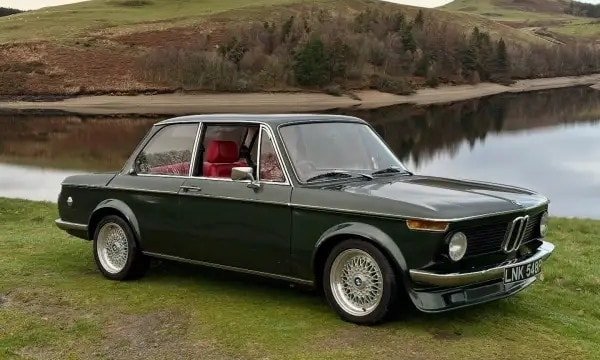
Based in the Welsh village of Newtown, ECC is one of the UK's premier battery EV-focused restomod shops in all the British Isles. Outside of EV swaps for classic British fare like Minis and Land Rovers, they can just as easily convert Beetles, old Mercs, VW Campers with the works, and even the occasional Aston Martin or Ferrari. But their latest creation, an early '70s BMW 1602, perhaps encapsulates what makes ECC unique better than any other.
The 1602 and the larger BWW 02 Series were a transformative car for BMW. Of course, most of the praise is skewed towards the timeless classic 2002 sports car. But make no mistake, there'd be no 2002, no radical graphics, and no racing pedigree without the 1602 that came before it. Unveiled in Geneva for the local 1966 Motor Show, the four-seat, two-door 1602 (1600-2 in early years) wasn't supposed to set the world on fire.
Rather, it was almost like a West German equivalent to a budget-friendly little saloon car, a bit like an Alfa Romeo GTV or a Datsun 510. Like either of those, the 1602 hyper-focused on the entry-level performance car market, where lightness and peppy engines mattered more than cubic displacement or cylinder count. Its short 98-inch wheelbase meant it was agile, and a 1,573-cc M116 four-cylinder engine kept weight down.
At 84 horsepower out of the box, the 1602 needed to be that light if it wanted to get out of its own way, and boy, it sure did. A three-speed automatic transmission was available, but even back then, everyone knew the four-speed stick shift was better. With rear-drive and a low-down driving position like a car far sportier than it really is, the 1602 walked so the 2002, and then later the M3, could run.
And now, ECC had to figure out how to take that same magic and make it work with an electric drivetrain that turns on every single time you start it. In effect, the goal is to make the car far more reliable, and arguably easier to live with, than had the old carbureted M10 still been under the hood. To those who think slapping an aftermarket Weber carb on the old motor would be just as good, consider what ECC's put together.
Obviously, this is the kind of restomod that requires a full rotisserie restoration on top of whatever was done to the powertrain and the chassis. With all the obligatory paint stripping and disassembly involved with all of that, the bare shell was ready to accept a 40 kWh battery pack, divided evenly between the engine bay and the trunk.
By staggering equal amounts of battery pack across either end of the chassis, ECC managed to maintain fun-friendly weight distribution in line with the original driving experience. In normal driving conditions, i.e., in town running around and light highway driving, ECC figures you can squeeze 140 miles (225 km). But even with factors like dreary and cold Welsh weather and sub-optimal traffic flows taken into account, this restomd will travel about as far as early modern compact EVs.
Powering the rear wheels is a single NetGain HyPer9 AC electric motor. At roughly nine inches in diameter and weighing just 120 lbs, just one of these motors jets 120 horsepower at 8,000 rpm, and 173 lb-ft of instantly available torque as soon as you mash the throttle. The unit is semi-passively cooled via an external heatsink at the bottom of the unit, deliberately protruding into the air stream just enough to keep itself at operating temperature.
The unit is IP56 sealed for a fairly hearty resistance to things like rain and light snow. This is the kind of electric motor that turns a finicky classic car into a viable daily driver. With the included SME AC-X1 Controller, the installation and tuning process is relatively plug-and-play if you're already a skilled restoration shop like ECC. Though, that term is relative, because every ECC build is a little bit unique.
This is especially poignant because what's most unique about this build is what ECC didn't change. That's right, the four-speed manual gearbox wasn't thrown out with the rest of the drive. Ordinarily, an EV is best suited for a one-speed, direct-drive transmission setup. Owing to the above-mentioned instant torque, there's no reason a manual gearbox can't be attached to the electric motor for some much-needed driver engagement.
Will this satisfy the kind of people who want to see all EVs put through a shredder? Probably not, but it does quash the common criticism that all electric cars look like laptops just as much as they drive like them. So to say, almost completely hands off, with ADAS up the wazoo, and in as unengaging a way as physically possible. This vintage BMW is still nothing like a modern EV in that regard, and that shows in the way it drives and how it handles.
With the extra power, this EV is producing similar power as the old BMW 2002 TI, the further performance optimized variant with higher engine compression and dual carburetors. Thanks to the torque curve native to every electric vehicle, this EV swap is far quicker off the line, and would most likely make quick work of a stock ICE equivalent in the quarter-mile and probably even far beyond.
The 1602's stock suspension might've been just fine for the early '70s, but ECC knew they could squeeze even better performance out of the chassis with a couple of mods. Brakes are aftermarket discs at all four corners, replacing the rear drum brakes that came stock with the 1602. The suspension is also drastically lower compared to the stock ride height, the direct result of an aftermarket suspension.
With the new shocks and springs, the car corners far flatter than it would have even when brand new. In so many ways, it's a faster, wilder, and more reliable take on arguably the most important BMW of the last 75 years. With the right expertise and a liberal dose of dedication, ECC managed to squeeze even more excitement out of a 1602 than perhaps even its designers thought it might be.
With that in mind, you might notice the interior and exterior match the engine. That striking dark green color is actually a Volkswagen-derived Oak Green paint shade that was also featured as an option on vintage Porsche 911s. The stock wheel arches look quite different compared to what ECC's done to this restomod, and that's because they come straight off a vintage Golf GTI.
Elsewhere, the stock front end has been modified, now sporting an Alpina chin spoiler originally designed for the E21 BMW 3 Series. Though, weirdly, it almost looks like the spoiler was designed to bolt right on to a 1602's front bumper. The finished work looks clean, polished, and downright factory fresh. Inside, the original right-hand drive configuration's been retained, and the interior is upholstered with contrasting black and red leather on the door cards, seats, and the gear stick.
It looks like a proper nice time to spend a road trip in, and we're sure whoever buys this car will feel the same. How much would it cost someone to buy an EV swap like this? If you ask us, they'll have stolen it for anything less than $100 grand.


Related News
