Man Buys 1961 Plymouth Fury Parked for Decades, Finds Out It's a Super Rare Gem
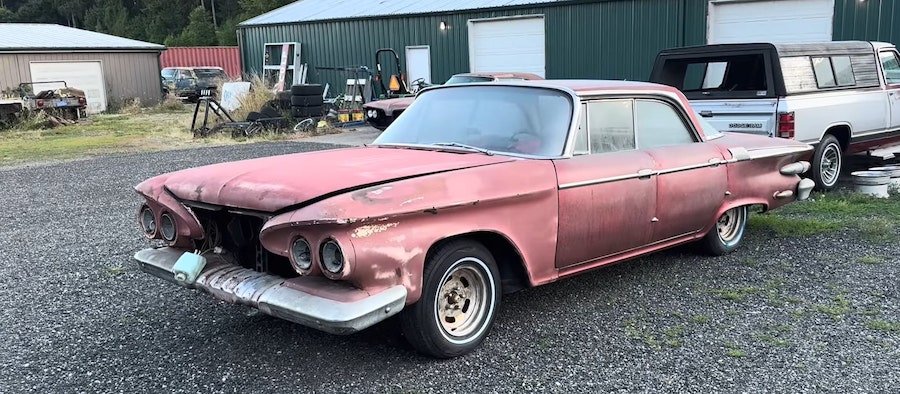
The 1960-model-year Chryslers looked sleeker than their predecessors and retained the large fins. However, the latter had fallen from fashion. While Ford and Chevrolet sales increased, Chrysler struggled to maintain the previous year's volume.
While the Chrysler division opted to keep tailfins on its cars for 1961, Dodge and Plymouth voted against them. But things didn't go well for them. The redesigned 1961 vehicles were simply too bold for the era and kept many customers away from dealerships. Plymouth sales dropped by 26%, while Dodge deliveries diminished by nearly 27%.
Things didn't get any better in 1962 either. Someone at Chrysler overheard that Chevrolet might downsize its lineup, and the company erroneously shrunk its full-size offerings across the board.
Now, I need to come clean about something: I'm one of those weird dudes who actually like early 1960s Dodge and Plymouth designs. I'd proudly display a 1961 Plymouth Fury on my front lawn. At the same time, I get why a lot of people dislike them.
But while they may not look appealing, early 1960s Chryslers had other things to brag about. For instance, they were available with solid performance engines. Since I mentioned the Fury, Plymouth had the Golden Commando and SonoRamic Commando, both good for over 300 horsepower. A lesser-known option, the SonoRamic is one of the hottest powerplants of the era. And it's quite rare, too.
The SonoRamic is essentially a B-block Commando with a cross-ram intake design. It featured 30-inch tubes with carburetors on opposite sides (and air pushed across the top of the engine), a configuration chosen due to a lack of room under the hood.
The layout boosted the midrange, but Chrysler engineers also designed a short-ram version with 15-inch tubes. The latter provided an extra boost higher in the rpm range, making these engines more suitable for racing.
The initial 361-cubic-inch (5.9-liter) SonoRamic V8 delivered 310 horsepower and 435 pound-feet of torque. The package then found its way onto the 383-cubic-inch (6.3-liter) unit, resulting in a higher output of 330 horsepower and 460 pound-feet of twist. The 361 SonoRamic was discontinued after 1960, while the 383 SonoRamic went into the history books after 1961.
Specific production figures for SonoRamic-powered Plymouths aren't available, but experts agree that only a few hundred Plymouths were sold each year. And far fewer are known to still exist. This 1961 Fury sedan is one of those 383 long-ram gems.
The Mopar was recently showcased by Tom of YouTube's "Rocket Restorations." Our host shares that the derelict Fury was found by a fan of the channel at an estate sale in Florida. The car had been parked for decades and features many old-school custom bits. Fortunately, that didn't stop Tom from buying it, which basically means he prevented it from becoming a parts car or being sent to the crusher. These four-door sedans are anything but desirable nowadays.
Despite all the heavy customization and the "too many doors" body style, this Fury deserves a second chance for the super-rare engine. And yes, the block and the long-ram tubes were still under the hood.
Tom says he's planning to get the engine rebuilt, put the front end back together, and make the Fury a driver. This obviously means it won't get restored, but it's confirmation that the Mopar won't end up as a rust bucket. And that's great news! Hit the play button below for the full walkaround and story.


Related News
