Renault 16 Super and TX driven on home turf – the original practical hatchback
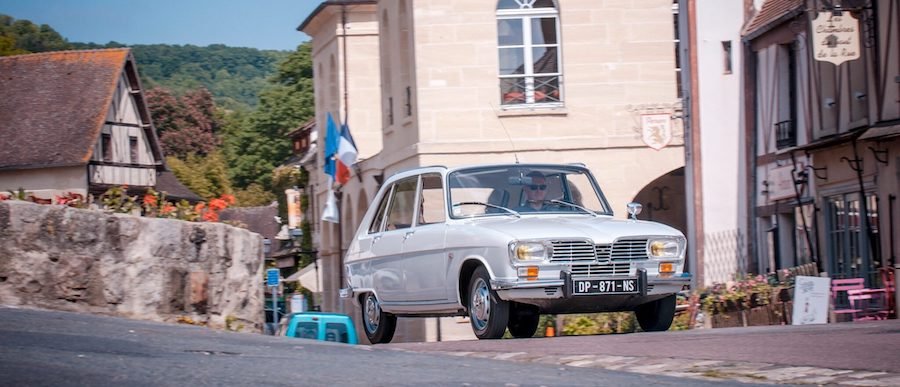
And that’s surprising, because this is not a car that put the French working man on wheels.
The Renault 16 is not a car in the mould of a 2CV or even the company’s own R4, yet it was certainly inspired by the latter. And even though the car that probably best owes its existence to this one is the Volkswagen Golf, it’s appropriate to think of the 16 as offering some of the appeal of the Citroën DS, only without the complexity.
As we lope over crests between flowering fields along a D-road towards the effortlessly pretty village of La Roche-Guyon (close to Giverny, beloved of the impressionist artist Claude Monet), the 1966 Renault 16 Super lives up to the promise of a junior luxury car, though not one in the wood ’n’ leather mould. There is much painted metal on show inside and the seats are trimmed in leatherette (wrapping polyurethane foam cushions rather than horsehair and springs), so there’s no ostentation to upset the liberté, égalité or fraternité. Instead it’s all to do with refinement, comfort, space and the ability to use the volume within as flexibly as you’d like, a subject we’ll return to.
Those seats are plump, broad and softly cosseting yet supportive too, while the all-independent, long-travel suspension makes for a notably absorbent ride, the kind that French cars used to be known for. There’s more body movement than you’d notice in a modern car but all bumps are rounded off and there’s absolutely no harshness over corrugations, nor is there any of that awful side-to-side checking you suffer in cars with an emphasis on roll stiffness.
Frankly there’s extremely little of that either, the R16 listing in response to every turn of the wheel, yet that’s fine because it does so with predictability and linearity, while the steering is far more precise than you might expect. This is a car that’s easy to place on the road, and it’s one your passengers will always enjoy travelling in.
Why was passenger comfort so important to Renault?
As it turns out, that’s very important to Renault, as we’re told beforehand at the usine in Flins, home to the Renault Classic heritage team (13-strong, with a stable of 750 cars, no less). It’s headed by Hugues Portron, obviously proud as he presents a collection of family-orientated cars ranging from a 1902 Type G to motor show concepts of recent years, all of which put the R16 into context.
‘Renault understood that cars were objects to be shared with other people,’ says Portron of the Type G, Renault’s first four-seater, before moving on to the 1924 Type NN, its first with a hardtop roof covering all those inside, plus a rear passenger door: ‘Making life easier is a Renault philosophy.’
Tellingly, all the cars in this presentation make a virtue of passenger comfort, the interior as a cocoon, somewhere safe for children; they are cars that don’t place macho driver appeal above practicality. And it doesn’t take long for the Renault 4 of 1961 (Octane visited in 2011 for its 50th birthday party) to take its turn in the limelight.
‘This was the beginning of our voitures à vivre,’ says Portron. That’s ‘lifestyle cars’, a phrase that sounds cloyingly like modern marketing speak yet carries much deeper resonance when attached to a vehicle as overtly functional as the R4. ‘Renault perceived that people were using cars differently: for work in the week and the countryside at the weekend. In 1961, this was the only saloon car with a tailgate hinged at the top [or, as Renault named it, the porte de service]. It was a revolution in car manufacture and for society, yet it took time to catch on because of its looks. People thought it looked like a commercial vehicle.’
‘There’s no ostentation to upset the liberté, égalité or fraternité. Instead it’s about comfort and space’
It’s certainly in contrast to the bland and hefty-looking saloon alongside it: Project 114, the sole surviving prototype of a traditional luxury saloon to replace the old Frégate of 1951. It’s powered by a purpose-designed 2.2-litre straight-six that drives the rear wheels, and it features front disc brakes, even hydropneumatic suspension. Surely it could have been an executive-car contender in its day? It’s important now for rather different reasons, as we later find out.
Why did Renault cancel Project 114?
The assembled motoring journalists and international Renault dignitaries move away from the Flins production plant in a fleet of R4s (if only modern superminis rode as comfortably as this little box) and a fabulously orange early R5 (even down to the shiny vinyl seats!) and meet up again at a sailing club, further along the banks of the Seine in an altogether leafier spot. Here we are introduced to the social historian and university professor Jean-Louis Loubet. As he tells us, Project 114 was cancelled in 1961, only three years after work began and two years before any chance of it being launched. Why? ‘There was an economic downturn in Europe,’ says Loubet. ‘It was too expensive for the times.’
And yet teams of stylists and development engineers had invested intellect and thought in this car, the pride of Renault, fit to take on Citroën’s radical DS. It was a clean-sheet car and it would be replaced on the drawing board by another, known (not surprisingly) as Project 115. ‘Cancelling Project 114 was one of the hardest decisions ever taken by [Renault design director] Yves Georges,’ says Loubet. ‘So he rallied his troops by asking them to design the car they would want to own themselves.’ And his young managers Gaston Juchet (design), Claude Prost-Dame (bodywork), Jacques Blondeleau (suspension) and Michel Petricenko (engine) delivered.
Renault’s chief executive Pierre Dreyfus was in love with the R4. Since 1957, he had been of the opinion that ‘a car should no longer be four seats and a boot. It should be a space.’ This was to be an upper-middle-class car rather than a luxury saloon and one that would deliberately be somewhat different from the live-axled, three-box Ford Taunus, Opel Rekord and Peugeot 404 that dominated in Europe. The front disc brakes were among few elements carried over from Project 114, while that 2.2-litre straight-six had a couple of cylinders lopped off to become a 1.5-litre overhead-valve four. There were to be no hydropneumatics for this pragmatic car, yet space-efficient all-independent torsion-bar suspension was still a cut above what its rivals could offer: fresh technology in this segment, if not so revolutionary as the hatchback packaging.
And while the Frégate’s replacement had been due around 1963 after a gestation of five or six years, in another revolutionary move Yves Georges implemented a development programme that would run design and engineering in parallel with organising the build process, rather than sorting the car then deciding how to construct it. And so this groundbreaking car was ready for production in 1965, only 3½ years since Georges had sold its concept to his disenfranchised crew. It truly lived up to its epithet of la voiture intelligente.
What is the Renault 16 TX like to drive?
There’s some time pressure at La Roche-Guyon. We’d love to stay a while amid its historic streets, soaking up that pavement café vibe, but we have to head back to the airport. And though the 1966 Renault 16 Super was a wonderfully relaxing way to meander along the D-roads, something a little more assertive is appropriate for making headway back towards Paris. And the 16 delivers again, this time in its final TX incarnation, recognisable by its square quad headlamps, a lightly restyled tail (rectangular lights and, get this, a spoiler above the rear window!), thick velour seats where stretchy leatherette once ruled, plus a five-speed gearbox, electric front windows and, a real innovation for those with shopping and kids to think about, central locking. Thus the 16 made its transition from Car of the Year 1966 to a car for 1970s executives.
The ride is still effortlessly capable of soaking up the worst ruts, and it still rolls in corners, yet the damping feels firmer, the whole car gymnastically supple rather than merely soft. And if the increase in capacity from 1470cc to 1647cc sounds academic, the effect it has on performance is marked.
Sure, the little Super is torquey and willing, but the TX adds snappy throttle response and a keenness to zip the rev counter needle around its dial (which was absent from the more basic dash layout of the older car). Its gearbox, despite that extra ratio, is still operated via a column shift, yet the action is easier and neater. In short, this car invites the driver to engage a little more, yet without forcing any discomfort on those sharing the cabin. Which perhaps makes it la voiture un peu plus intelligente.
What made the Renault 16 so practical?
None of the practicality is lost in this transformation to sporting saloon. During its 15-year career, during which 1,845,959 16s were built, the core structure was never altered. It had some quirks, too: accommodating the transverse rear torsion bars alongside one another made for a wheelbase 2.76in longer on one side than the other, and positioning the gearbox ahead of the longitudinal engine reduced understeer but made servicing a pig of a job. Yet that characterful styling matured beautifully, never suffering the ignominy of overt utilitarianism that plagued the R4, because Gaston Juchet was encouraged to think about the R16 as much as a spacious coupé as an estate car (it was sold in the USA as the ‘sedanwagon’).
There are six seating configurations that involve sliding, flipping, folding or removing the rear bench, and they range from tradesman’s van via lady wife’s shopping carriage to a space tailored around transporting a carrycot securely. Equally, that body is as much about rigidity and aerodynamics as it is capacity, with a strengthened floorpan and single-piece bodysides to prevent torsion wrought by the lack of a boot partition. The pagoda-style roof eliminates unsightly (and drag-inducing) drip rails, while the channelled roof-panel controls airflow and increases panel rigidity, to the benefit of refinement too.
As for what followed in the Renault 16’s wake, it’s said that Volkswagen’s bosses, tired of such Beetle rehashes as the 411, ordered that its own design department should take a close look at what la Régie had achieved. And the Golf happened. Simca’s 1100 came close in 1967, but was smaller and less refined, while Britain responded in 1969 with the Maxi, although few mainland Europeans noticed.
And, let’s face it, if you were driving one of those today, even in the UK, would you expect such a positive reaction from fellow road users? No, thought not.
1966 Renault 16 Super specifications
| Engine | 1470cc four-cylinder, OHV, single Solex carburettor |
| Power | 59bhp @ 5000rpm |
| Torque | 78lb ft @ 2800rpm |
| Transmission | Four-speed manual, front-wheel drive |
| Steering | Rack and pinion |
| Suspension | Front: double wishbones, longitudinal torsion bars, telescopic dampers, anti-roll bar. Rear: trailing arms, transverse torsion bars, telescopic dampers, anti-roll bar |
| Brakes | Discs front, drums rear |
| Weight | 980kg |
| Performance | Top speed 91mph. 0-62mph 16.9sec |
Related News
