1969 Firebird Sprint Is Rarer Than Trans Ams, Needs Lots of TLC, Owner Wants To Know What It's Worth
However, buried deep within the history of the Pontiac Motor Division lies a fascinating mechanical anomaly that defied conventional Detroit engineering dogma. One that actually ended in the last year of the sixties. And this Firebird OHC proudly wears it to this day.
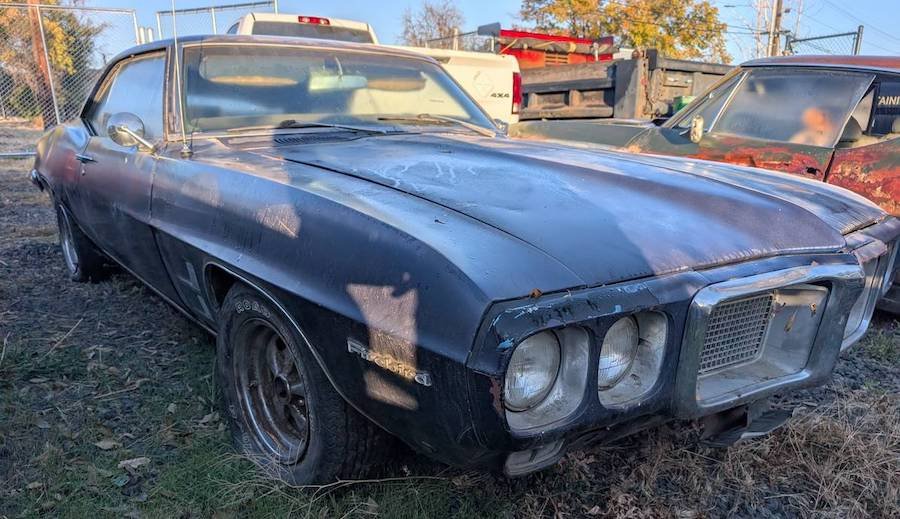
The subject is a 1969 Pontiac Firebird coupe finished in black (a very matted, worn, weathered, and patina’ed kind of black), showing 100,000 miles on the odometer. According to the owner, the pony car retains its factory-installed engine and automatic transmission, and it left the assembly line equipped with the elusive “Sprint” performance package.
What that is/was? An exercise in Europeanization, coming off the drawing boards and think tanks of the most Euro-prone General Motors division of them all: Pontiac. After Semon Knudsen transitioned the “old man’s car” of the early fifties into the performance powerhouse of the early sixties, Pontiac’s own John Zachary DeLorean decided a heavy dose of Old World flair was in order.
The GTO would be the immediate example, but there have been other attempts (anyone remember the Banshee prototype?). However, badges and monikers alone wouldn’t cut it, so the ambitious manager took on a new challenge: revolutionize the Detroit school of thought right from the core of its beating heart. Which, in Yank terms, means making a pushrod V8 feel embarrassed of itself. Enter the OHC-6.
“Over-Head Camshaft,” six-in-a-row. What more European than that could Pontiac go? V12 would be a good answer. However, Pontiac went only halfway, and stopped at six cylinders. It’s not that the idea was new to Motor City (Sixes had been around for a long while). It was the trickery of the missing pushrods that made the engine so exotic.
And it’s precisely that exact element that makes the car in the gallery so rare to begin with – and quite significant, if we consider that there were no more OHCs straight-sixes made by Pontiac after that model year. In fact, it would be more than three decades before GM considered another go at the idea, with the Vortec 4200 of the Atlas family of engines. More recently, the Mopar “Hurricane” (introduced in 2021 as the SIXPACK) put a new twist on the six-decade-old idea.
However, for full historic disclosure, let’s give full credit to Kaiser-Jeep for introducing the OHC Six in mass production, in 1962. The “Tornado” was a 230-cubic-inch SOHC straight-six engine featuring a hemi-head design, and a single, six-lobe camshaft for the transversally-opposed valves. That’s right, each lobe opened both the intake and the exhaust valves.
The Jeep Tornado engine holds the distinction of being the only engine completely designed, developed, and built by Kaiser-Jeep during its ownership of the brand. Maybe John DeLorean had found inspiration nearby, and not all the way across the Atlantic, after all? Who knows? One thing is certain. Jeep retired the civilian version at the end of 1965, because the engine was far too demanding in terms of high-grade maintenance.
Back to the car in the gallery. It’s a rough ’69 Firebird, and it’s also a very rare one. How rare – and why so rare? Precisely because of that elusive powerplant, easily identified by the unmistakable die-cast aluminum cam housing.
That one-of-a-kind piece is the telltale of the Pontiac Overhead Cam. Debuting for the 1966 model year and ending production after 1969, this powerplant replaced the aging Chevrolet-designed pushrod inline-6. Over its four-year lifespan, the engine exclusively powered the intermediate A-body line—comprising the Tempest, Tempest Custom, Safari wagon, and LeMans—alongside the F-body Firebird from its February 1967 introduction through 1969.
Instead of traditional pushrods and rocker arms, the engine utilized a single overhead camshaft driven by an external, fiberglass-reinforced neoprene toothed timing belt. That last bit was an industry first for an American mass-production powerplant – and the engine’s Achille’s heel. Stationary hydraulic lash adjusters acted as pivots for hardened iron cam followers. Initially displacing 230 cubic inches in 1966 and 1967 (coincidence with the Jeep Tornado?), the block was stroked for 1968 and 1969 to reach 250 cubic inches (4.1 liters).
While the standard 1969 OHC-6 inhaled through a single-barrel Rochester Monojet carburetor to produce 175 horsepower at 4,800 rpm and 240 lb-ft of torque at 2,600 rpm with a 9.0:1 compression ratio, the W53 “Sprint” option transformed its character. The upgrade added a four-barrel Rochester Quadrajet carburetor, a dual-cast split exhaust manifold, stiffer dual valve springs, a heavy-duty floor-shifted transmission, and a 10.5:1 compression ratio.
For the 1969 model year, the 250-cubic-inch engine featured a 3.875-inch bore and a 3.525-inch stroke. Interestingly, Pontiac calibrated the 1969 Sprint engine differently depending on the selected gearbox. Models paired with the manual 3- or 4-speed transmissions received an aggressive camshaft with 260 degrees of duration and 0.438-inch lift, generating a factory rating of 230 horsepower at 5,400 rpm and 260 lb-ft of torque at 3,600 rpm.
Conversely, when buyers ordered a 1969 Sprint with an automatic transmission—either the 2-speed Super Turbine 300 or the 3-speed Turbo Hydra-Matic 350—Pontiac installed a slightly milder camshaft featuring 244 degrees of duration and 0.438-inch lift. This specific automatic configuration, which powers the coupe featured here, delivered 215 horsepower at 5,200 rpm and 255 lb-ft of torque at 3,800 rpm, offering smoother low-end idling in gear.
Across the entire first-generation run of 277,380 Firebirds, only 57,051 examples left the factory with any variant of the OHC-6. That total breaks down into 17,664 units in 1967 (out of 82,560 Firebirds), 18,494 units in 1968 (out of 107,112), and 20,893 units in 1969 (out of 87,708). Out of that three-year total, the high-compression Sprint package accounted for roughly 13,352 cars, representing under 5% of production.
Breaking down the Sprint figures by year and configuration highlights the scarcity of this car. In 1967, Pontiac built 7,210 Firebird Sprints across coupes and convertibles, split between 5,316 manual-shift cars and 1,894 automatics. For 1968, Sprint orders dropped to 4,662 units, comprising 4,005 hardtop coupes and 657 convertibles. By 1969, as buyers overwhelmingly favored eight-cylinder power, Sprint production plummeted to 1,979 units (267 of them convertibles).
Within the 1969 OHC-6 lineup of 20,893 Firebirds, the vast majority were base 175-horsepower coupes and convertibles equipped with automatic transmissions. Across all 1969 Pontiac lines, factory engine records show just 3,242 Sprint 250 blocks assembled: 2,357 manual-transmission ZH-code engines and 885 automatic-transmission ZL-code units.
For the 1969 Firebird Sprint specifically, only 54 convertibles were built with automatic gearboxes, out of the 267 total ragtop Sprints, while automatic Sprint coupes accounted for just 428 copies. The manuals reached 1,284 units. If you really want to go down the production stats rabbit hole, hold on tight: of the total of 1,712 Firebird coupe Sprints assembled for the 1969 model year, only 397 came from the Norwood facility in Ohio. This is one of the 94 automatics made there.
The Lordstown , OH, plant takes the crown, with 887 coupes (237 autos), while the Van Nuys, California assembly lines left out 428 solid-roof Sprints (97 with a self-shifting cogbox).
Back in the day, contemporary automotive publications praised the Firebird Sprint for its balanced weight distribution and nimble front-end handling compared to nose-heavy eight-cylinder counterparts. Period road tests of 4-speed Sprint models recorded 0-to-60 mph sprints in 7.8 to 8.2 seconds and standing quarter-mile runs of 16.0 seconds at 88 mph, with a top speed of 124 mph, while automatic and convertible variants clocked high-18s quarter-mile passes.
So this car is rarer than a same-year Trans Am. It’s also a lot less valuable, which may have a lot to do with the condition. The pictures are speaking volumes – this car was not loved, not one bit. The most noticeable structural flaw is the caved-in rear quarter on the driver’s side. The owner points out that a replacement stamping is already in transit.
There is rust and dust and missing paint and saggy rear-right wheel lip molding, but the glass, stainless window trim, and rear valance appear solid. Inside the cabin, the dashboard and door panels with integrated armrests look complete, and the seats are in surprising good shape, too. The engine and transmission are original, and the condition is described as “pretty close to original.”
Its current residence is Spokane, WA, and the owner is asking $15k for it. But that’s just shaking the tree to see how many monkeys fall off – he doesn’t really need to sell. However, he may be off the mark with that value, as many gearheads don’t have good words about the OHC-6’s tendency to fall out of sync once the timing belt elongated past the point of elasticity, resulting in a bad timing and all the other associated headaches.


Похожие новости
