Banned by NASCAR: This 1957 Chevrolet 150 Fuelie Is an Ultra-Rare Black Widow
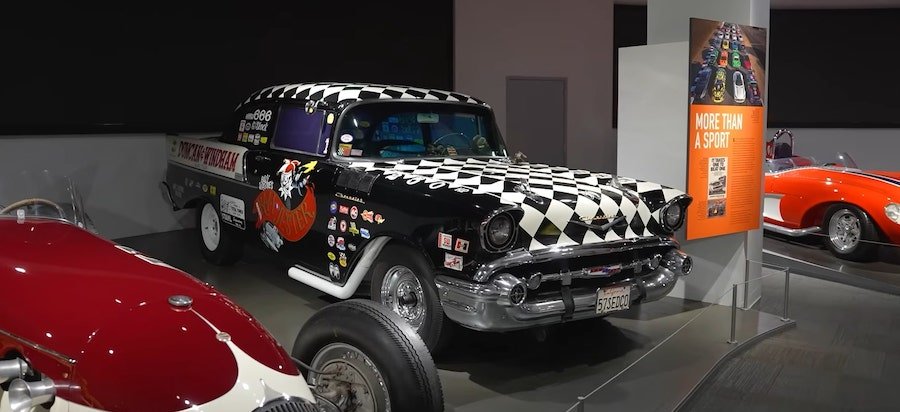
Even though it's not usually associated with high performance, the Tri-Five helped Chevy win a NASCAR championship. The 1957 One-Fifty you see here is one of those cars.
Don't let the drag-spec features fool you, this Chevy was actually born to tackle oval tracks in the NASCAR series. The vehicle was restored to its last racing configuration from the 1960s, but it came to life as a Black Widow car. It's one of six units produced and a valuable piece of NASCAR history.
The Black Widow was created during the Automobile Manufacturers Association's (AMA) ban on factory racing. The decision was taken following Congressional pressure after the tragic accident that killed over 80 people at the 1955 24 Hours of Le Mans. Instead of waiting for Congress to regulate their involvement in racing, automakers opted for a self-imposed ban. Or at least that's how it seemed from the outside.
Like most US carmakers, GM did everything it could to get around the self-imposed restrictions. The Black Widow resulted from these efforts, which included establishing a new company called Southern Engineering and Development Co., or SEDCO.
Ran out of Nalley Chevrolet in Atlanta and led by former Hudson race engineer Vince Piggins, SEDCO turned the entry-level 150 Utility Sedan into a NASCAR powerhouse. The two-door coupe was stripped of its heater, radio, and rear seats, and got a 20-gallon (76-liter) fuel tank and a fuel-injected 283-cubic-inch (4.6-liter) V8 engine developed by Smokey Yunick.
At the same time, Piggins put together a manual explaining how Chevrolet dealers and customers could build their own Black Widows. Mailed to over 400 dealerships, the manual also included information on the 170 GM-made parts needed to convert a Chevy 150 into a race-spec Black Widow. Yes, all these components were available over the counter.
The cars performed well at the track, and Buck Baker went on to win the 1957 championship. The Black Widows scored 16 wins and 63 top-five finishes that season despite a mid-season ban on fuel injection, which left them running on carburetors.
It's unclear exactly how many 150s were converted to Black Widow specs, but SEDCO reportedly produced only six units. Two of them were used to develop the fuel-injected engine. This Black Widow is one of those rigs. It also retains many of its original SEDCO components.
The Chevy is currently in the Petersen Automotive Museum, sharing the "Driven to Win" exhibit with 10 other race cars, including a 1969 Dodge Charger Daytona. Hit the play button below to learn more about it.


Похожие новости
