Super-Rare 1958 Crown Convertible: Pure Imperial Majesty With the Biggest First-Gen Hemi
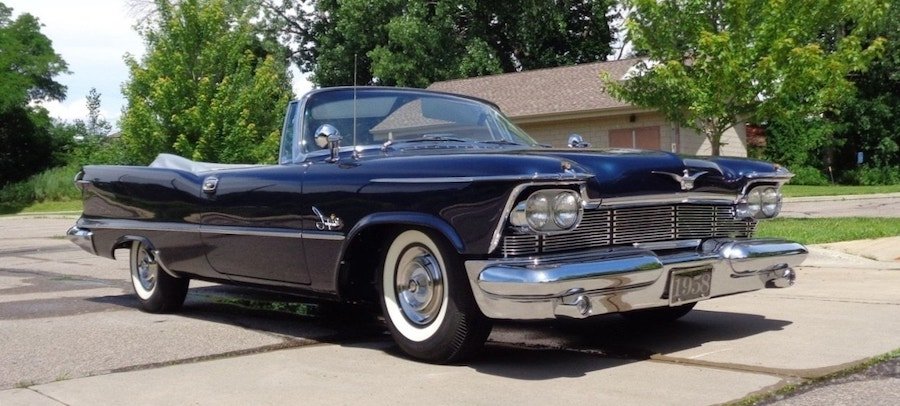
Cadillac was always America’s luxury sweetheart, but Chrysler’s high-end division, Imperial, lived fully up to its monarchical name in the Forward Look years. What it lost in showroom traffic, it made up in styling, glamour, glitz, and chrome. Lots of chrome. A late-fifties Imperial could have stood tall in any presidential parade for Dwight D. Eisenhower – but that would have been too… mundane (as incredible as this sounds).
However, being Imperial, it never quite meshed with the most republican nation on Planet Piston—not in sales, anyway. And here is an example that proves just how far above the crowd Chrysler’s notion of luxury really stood in 1958.
Randy Guyer is famous for his Mopar collection from the fabulous fifties. His cars could assemble into a full-blown motorcade for the Emperor of Japan. Because if a ruler of an empire would only ride Imperial-style, here’s a 1958 Crown convertible that could make a celestial sovereign feel like he was floating on a heavenly cloud from which he descended to rule his subjects.
The Imperial name had already broken free of Chrysler by 1955, a stand-alone marque meant to face Cadillac and Lincoln head-on. By 1958, the styling under Virgil Exner was outrageous and extravagant. Swallow-strainer taillights, chrome that gleamed like a thousand mirrors, crowns embedded on wheel covers and door panels—it was nothing short of automotive theater. Chrysler called Imperial “America’s most distinctive fine car.” Looking at Randy’s midnight blue convertible, it’s clear they weren’t exaggerating.
In total, Imperial production for 1958 reached just 16,133 units across Custom, Crown, and LeBaron lines. Of those, only 675 were Crown convertibles. That makes Randy’s car one of the rarest and most glamorous Imperials ever assembled, a machine whose exclusivity matched its price tag. By contrast, Cadillac built over 121,700 cars in 1958, while Lincoln turned out about 24,800 units.
Cadillac’s Series 62 started around $4,600, with the glamorous Eldorado Biarritz at about $7,400. Lincoln’s Capri and Premiere hovered near $4,900–$5,300, while the flagship Continental Mark III stretched past $6,000. Imperial’s $5,390–$5,760 base price put it right in the thick of Cadillac and Lincoln’s finest, but its rarity made it almost exclusive by default.
Prices began at $5,390 and stretched toward $5,760 before options. That was more than a Cadillac Eldorado Biarritz, and far above Lincoln’s Continental. Limousines built by Ghia cost a staggering $15,000. Standard features were themselves a luxury manifesto: power steering, power brakes, push-button Torqueflite automatic, electric windows, Solex tinted glass, even a six-way power seat.
Buyers with deeper pockets could add air conditioning, cruise control called “Auto-Pilot,” power door locks, rear window defoggers, and the flamboyant Flitesweep deck lid. But the real Imperial trump card sat under its heavy hood: Chrysler’s legendary 392-cubic-inch Hemi V8.
This was the final year the first-generation Hemi appeared in Imperial. With a 10.0:1 compression ratio, it made 345 hp (350 PS) and roughly 450 lb-ft (610 Nm) of torque. In 1958, that was thunderous. At nearly 5,000 pounds (2,270 kg), the car moved with a “flow of power” rather than brute force, but it had no shortage of authority.
The Hemi had been Chrysler’s pride since the early fifties. Plymouth and Dodge dabbled with smaller hemispherical heads, but Imperial received the grandest expression. The 392 was the pinnacle, larger and stronger than the 354s and 331s that came before it, and far more potent than most Cadillac or Lincoln V8s of the day.
In demolition derbies, Imperials became so un-demolishable thanks to their massive frames that they were eventually banned. The car was that tough – an iron fist in a silk glove (no, not velvet). Step inside, and the experience is no less imperial. Randy’s car greets you with a golden sill plate crest cushioned by rubber spacers.
The speedometer dominates the dashboard like a clock tower. Push-buttons replace a conventional gear lever, and even the radio can be tuned by tapping a pedal with your foot. Ashtrays glide open like jewelry drawers, and the interior is trimmed in cloth, vinyl, chrome, and crowns, crowns everywhere.
Randy bought this car in 2016, tucked it away, and began its restoration in 2018. Six painstaking years later, it was completed in the fall of 2024. Lou Costabile’s camera captures the result: a midnight blue statement piece that gleams like a royal coach. When asked if it drives like a Cadillac, Randy doesn’t hesitate: “No, it drives like an Imperial.”
And he’s right. Smooth, quiet, tank-solid, yet regal in the way it commands the road, it is as much a throne as it is a car. Lou joked the dark blue makes the car look slimmer, and Randy quipped back that it makes him look slimmer too. Humor aside, nothing about this convertible hides its size or its purpose. It was designed to be seen, admired, and envied. (Then again, Lou only films cars that fall in those brackets - check out his channel; and why not subscribe for more?)
Collectors know Randy not only for his Imperials, but also for his De Sotos—cars that share the same exuberant Mopar DNA. Together, they form a court of American luxury unlike anything else on the planet. If Cadillac was the prom queen, Imperial was the mysterious royal guest from abroad: exotic, expensive, and dripping with confidence.
Today, concours-level ’58 Imperial Crowns can reach well into six-figure territory, though still lag behind Cadillacs of the same era. That makes them one of the great bargains in American luxury, a chance to own a car rarer, bolder, and, some would argue, more beautiful than its rivals. Randy Guyer’s example proves that with patience, resources, and vision, Imperial majesty can still ride again—top down, Hemi humming, chrome blazing in the sun.


Related News
