Odometer Says 8,800 Miles: Ragtop 1957 Bel Air V8 Has Prospects Throwing Money at It
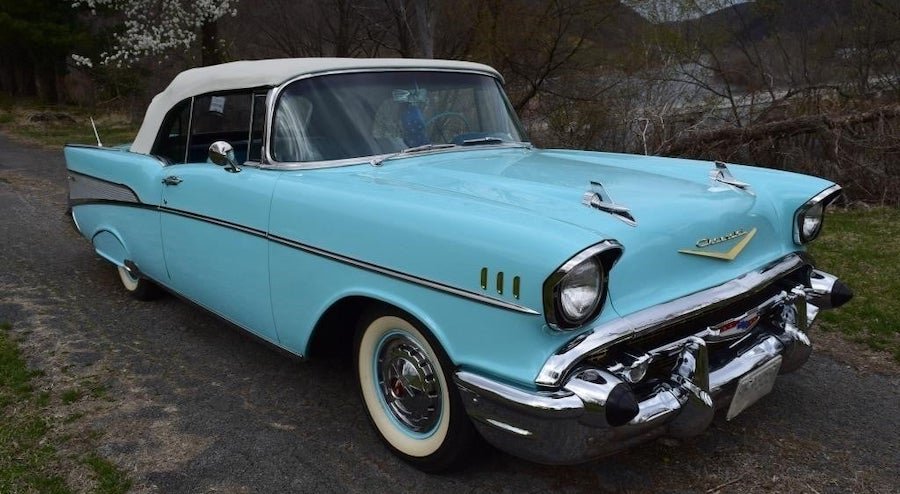
With around five million units sold in the three model years, the iconic cars are some of – if not THE – most successful products of Detroit ever to hit the streets. Understandably, they are a treasure trove for gearheads today – and here’s a ’57 ragtop Chevrolet Bel Air to prove my point.
The 1955 model year brought about landslide-sized changes in the Bowtie sales brochures, with the company breaking away for good from the prewar influences that haunted car production for almost a decade after the Second World War. Chevrolet wasn’t standing pat, and mavens from the best-selling carmaker in the world at the time did not miss the opportunity.
The 1955 models were fresh-appearing, forward-looking (perhaps not as much as their Chrysler rivals, but fairly close), and technically inspiring. They were also cheap – enough to convince millions of buyers to swarm into showrooms and take one home. The highways were spreading across the United States of Automobile like wildfire, hand in hand with the auto industry’s quantum leap advancements in all fields, from styling to technology.
The workhorse of this impetuous march into the post-war era was Chevrolet, the low-price division of General Motors that came in three basic versions and up to twenty variations in the Tri-Five period. Mind you, this was a time when all American carmakers were still using a one-size-fits-all platform (the future ‘full-size’ of the sixties).
The 150, 210, and Chevrolet Bel Air are probably the defining automobiles of the mid-fifties, and they haven’t lost their luster in the many decades that have passed since their termination. Expectedly, with huge production volumes comes a vast spectrum of possibilities, ranging from boneyard derelicts to hands-down ‘jump-right-in-and-drive-it-home’ examples that have prospects swarming around them like bees to honey.
That’s the case with the car in the gallery, currently located in Narrows, Virginia, which has garnered 61 (sixty-one) bids for the right to own it from thirteen different people, and the count is still on. That’s not the curious part, though – a final-year Tri-Five with a V8 is bound to get attention, especially one that looks as good as the ragtop in the gallery.
That’s right, this Chevy is one of the ‘rare’ convertibles made during the 1957 model year, with its production numbers falling into the five-digit range at 48,068 units. Stop laughing; the other body styles were high-sellers (six-figure cars for the most part, except the wagons and the two-door sedan, or pillared coupe, if you prefer this terminology). Strangely, the ad on the online auction site is very skimpy with details about the car.
Make, model, body style, VIN, mileage, and four options- that’s it – no further info on this smart-looking automobile. We learn that it comes with power windows and power seats, an automatic transmission, and a V8. Piston displacement is not specified on the website, but it is disclosed as a 283 in the video below – play it at 07:30 to hear it run briefly.
There’s no info about the gearbox, whether it’s a Powerglide or the Turboglide; both were available with either variant of the Turbo-Fire 283 V8, the 185-hp two-barrel, or the single-quad Super Turbo Fire 283, rated at 220 hp. The odometer reads 8,764 miles - probably rolled over unless it’s been reset during the restoration. Notably, the powertrain is the original hardware installed 68 years ago – and if that four-digit mileage is genuine, then the high bid of $64,000 is not even close, with 15 days left of the online auction.


Notícias Relacionadas
