How a 1996 speedboat record created one of the wildest interiors of the 1990s from Maserati
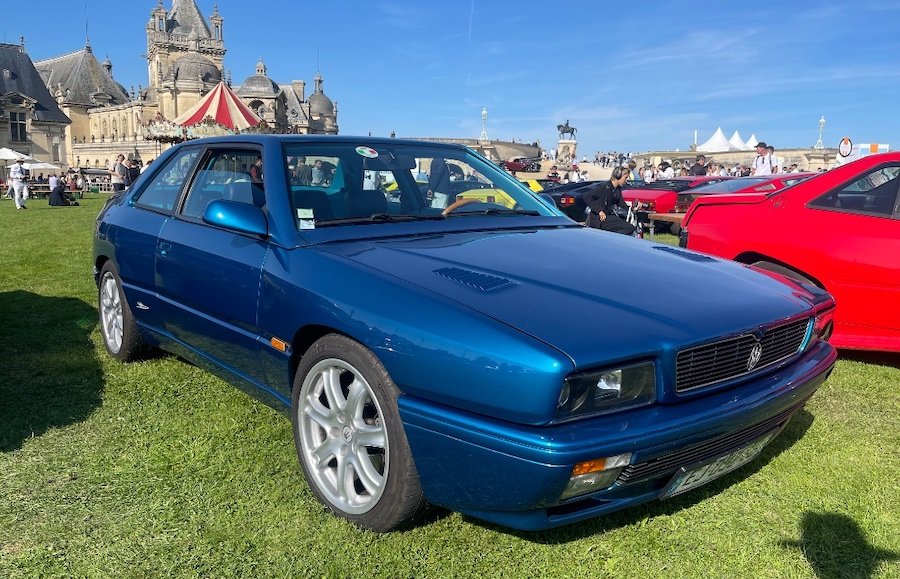
A month later, Maserati unveiled a special-edition Ghibli celebrating the achievement. There was no increase in horsepower, no elaborate aerodynamic package and no change in the car’s performance. Instead, Maserati covered much of the interior in turquoise leather, blue Alcantara and matching carpets. Thirty years later, the Ghibli Primatist remains among the more eccentric products to have emerged from the factory in Modena. Its origins were rather more serious.
The project was conceived by Bruno Abbate, whose Primatist boatyard on Lake Como had established a reputation for high-performance leisure craft. Abbate came from an Italian boatbuilding family and had extensive experience of powerboat competition, with his business achieving considerable success in offshore racing during the 1980s. A world speed record would provide valuable publicity for Primatist, and Abbate approached Maserati for an engine. There was already some history between the marque and powerboat racing. In 1954, a Maserati 150S racing engine had been installed in the Timossi-built hydroplane Maria Luisa IV, which subsequently established a class record exceeding 170km/h on Lake Iseo with Liborio Guidotti at the controls.
For the 1996 attempt, Abbate selected Maserati’s 2.0-litre twin-turbocharged V6, developed through successive generations of the Biturbo family. Its small dimensions and high specific output made it attractive for a lightweight racing catamaran, although the competition regulations presented a problem. Under the Union Internationale Motonautique’s equivalency formula, the turbocharged engine was classified as having a capacity of approximately 2.8 litres. That would theoretically have allowed it to compete in a 3000cc category, but no such class was recognised for the record. Abbate’s boat therefore had to compete in R5000, with a minimum weight of 600kg. It was a substantial burden for a relatively small-capacity engine.
Italian competition-engine specialist Romeo Ferraris was enlisted to develop the V6 for marine use. The two turbochargers were repositioned towards the rear of the engine, necessitating new exhaust manifolds and extensive changes to the pipework. Boost pressure and cooling arrangements were also modified, with the finished engine reportedly producing approximately 400bhp at 8100rpm. The contemporary roadgoing two-litre Ghibli developed around 302bhp. The modified V6 was installed in a purpose-built DAC catamaran, constructed using carbonfibre and other composite materials. Although it followed the general layout of contemporary Formula 1 inshore racing boats, the hull was wider and heavier to satisfy the R5000 regulations.
ts aerodynamic treatment was particularly distinctive. A substantial vertical fin rose from the rear bodywork to improve directional stability, while two smaller winglets were mounted towards the back of the sponsons. One was arranged to generate lift, the other downforce, allowing the team to influence the boat’s attitude as its speed increased. A specially developed Z-drive installation transmitted power from the inboard engine to the stern-mounted propeller unit. The installation demanded careful packaging, particularly given the additional cooling requirements of the twin-turbocharged Maserati V6.
Abbate recruited Guido Cappellini to drive the boat. By 1996, Cappellini had already established himself as one of the leading figures in Formula 1 powerboat racing, winning four consecutive world championships. The record attempt took place off Campione d’Italia, on Lake Lugano. Conditions on November 4 were almost ideal, with sunshine, little wind and exceptionally calm water. Cappellini was required to complete two timed passes in opposite directions over a measured kilometre, with the average speed determining the official result. The figure of 216.703km/h established a new R5000 world record, with the boat reportedly reaching 223km/h during the attempt. Two days later, Cappellini returned to the lake and reached a reported 230km/h, although the subsequent attempt did not improve the official record. The achievement was for the R5000 category rather than the outright world water-speed record, but it gave Maserati an internationally recognised success to celebrate.
It also came during a difficult period for the company. Fiat had taken complete control of Maserati in 1993, ending Alejandro de Tomaso’s ownership, but the road-car range still relied heavily on engineering developed during his tenure. The Ghibli II had arrived in 1992 and the Marcello Gandini-designed Quattroporte IV followed in 1994. In 1996, the latter gained the Shamal-derived 3.2-litre twin-turbocharged V8, while work continued on the coupé that would eventually become the 3200 GT. Maserati had also returned to circuit racing with the Ghibli Open Cup championship in 1995. The one-make series used specially prepared versions of the two-litre coupé, but its second season was abandoned after just two rounds in 1996, with costs cited as the reason.
The powerboat project gave Maserati publicity for its engine technology beyond conventional motor racing. It also involved an established Italian manufacturer whose products were sold to a similarly affluent clientele. By December 1996, the record-breaking boat had become the centrepiece of a special display at the Bologna Motor Show. Alongside it stood the Ghibli Primatist, with promotional material carrying the slogan ‘Born from a World Record’.
The road car was based on the Ghibli GT, introduced in 1995 as the final major development of the coupé. By then, Maserati had spent several years addressing weaknesses in the original car. The first two-litre Ghibli had already been equipped with a six-speed Getrag manual gearbox when it appeared in 1992. Subsequent revisions brought improvements to the ignition and cooling systems, with the 1994 model-year changes including ABS, revised bonnet ventilation and additional rear suspension location. Electronically adjustable Koni dampers were also available before the GT appeared.
The GT’s principal mechanical development concerned the rear axle. Maserati replaced the earlier Ranger limited-slip differential with a ZF unit, mounted within a substantial tubular supporting structure. Related hardware was already used in the Quattroporte IV, and the revised installation provided more substantial location for the differential and suspension components. Changes to suspension geometry and settings continued the work undertaken on earlier Ghiblis, while the later GTs received revised braking equipment and seven-spoke, 17-inch Mille Miglia alloy wheels. These became one of the easiest ways to distinguish the GT from earlier cars, replacing the smaller 16-inch wheels previously fitted. Other identifying details included dark headlamp surrounds in place of the earlier silver finish, changes to the exhaust arrangement and the deletion of the dummy fuel-filler flap from the left rear quarter panel.
The Ghibli Cup benefited from related chassis development but had a considerably more specialised specification. Its two-litre V6 produced approximately 325bhp, while its suspension, braking system and five-spoke Speedline wheels reflected its close association with the Open Cup racing programme. Instead, the Primatist used the standard two-litre GT engine, producing approximately 302bhp, together with the regular six-speed gearbox, differential and suspension settings. Maserati concentrated its efforts on the appearance.
The bodywork was finished in a metallic blue known as Blu Mare, also described in period material as Ultramarine Blue. It was complemented by the GT’s dark headlamp surrounds and silver alloy wheels, with commemorative Primatist emblems fitted to the rear quarter panels between the doors and wheelarches. Inside, Maserati made far more extensive changes.
he seats retained their standard Ghibli GT structures, but were trimmed in a combination of vivid turquoise and darker blue leather. The lighter colour covered the outer sections, contrasting with darker central panels, and the treatment continued across the rear seats. Blue leather was extended to the dashboard and door panels, with Alcantara used for additional trim sections. Bright blue carpeting covered the footwells and rear passenger compartment, while the lower dashboard and centre console carried the same colour theme.
The materials themselves were familiar from contemporary Maseratis. Their colours were anything but. The Ghibli’s standard interior combinations generally involved black, grey, beige or tan leather, often accompanied by dark carpets and heavily figured wood. The Primatist retained the Ghibli’s extensive wooden trim, but used a lighter shade of briarwood on the dashboard, door inserts and steering-wheel rim. The wooden gearknob remained, as did Maserati’s traditional gold oval dashboard clock. Against the blue leather, the pale wood was especially prominent. The colour scheme was intended to evoke the world of luxury motorboats, with the combination of leather, polished wood and turquoise trim providing the connection to Abbate’s Primatist range. The actual leather colours are notably lighter than they appear in some of Maserati’s period studio photographs.
An initial production run of 60 examples was reportedly envisaged, but fewer were completed. Older specialist records frequently quote 35 cars, while Maserati’s November 2026 anniversary announcement states a total of 36. Production took place in 1997, following the Bologna unveiling. The cars were built in left-hand-drive configuration and predominantly associated with the Italian market, although some were exported. One documented example was reportedly exhibited at the Geneva Motor Show before being delivered to its first Swiss owner in June 1997.
The limited production run has made the Primatist a rare sight, even among Ghibli enthusiasts. Ordinary Italian-market two-litre Ghibli GTs remain relatively affordable compared with other Maseratis of the period. In December 2025, a 1995 Ghibli GT with 155,184km sold at Dorotheum for €22,000 before auction fees. More recent advertisements have included a 1996 GT with 105,000km at €36,000 and another with 95,900km at €39,420. Primatist asking prices are considerably higher. During 2026, a 58,000km example in Greece was advertised at €55,000, while in recent years Italian specialist Garage Ponzio offered another at €62,000.
Ferrari took management control of Maserati in July 1997, while the Primatist was still being delivered. The following year, the Ghibli made way for the 3200 GT, ending a coupé line that had evolved from the original Biturbo of 1981. The Primatist was among its last derivatives, produced at a time when Maserati was still finding new uses for an engine that had been in development for more than 15 years.
That engine had just propelled a racing catamaran to 216.703km/h, with the help of some 400bhp, bespoke aerodynamics and one of the world’s best powerboat drivers. Maserati celebrated by building 36 Ghiblis with no extra power whatsoever, but more turquoise leather, blue Alcantara and matching carpet than anyone could reasonably have expected. It was an extraordinary way to celebrate a feat of engineering, and one that no subsequent Maserati special edition has come close to repeating.
Похожие новости
