6 photos
1979' Mazda Se
Report This Ad!Rate This!Bookmark This
NegotiablePublished 20 May 2026ID: LnPJLX
Expired
4 months, 3 weeks ago
4 months, 3 weeks ago
Information from the owner
Body: Sports Car
Age: 47 years
Mileage: 49119 km
Displacement: 1146 cc
Fuel: Petrol
Transmission: Manual
Exterior color: Green
Seller's comments about 1979' Mazda Se
Developed with the theme of "pursuing the joy of driving," the Mazda Savanna RX-7 (SA22C), released in 1978, was the first model in the RX-7 series, following the FB, FC, and FD. It is a historically significant car, featuring a lightweight body and a rotary engine.
In 1979, at the Daytona 24-hour race held in the United States, despite being a newcomer, it won the GTU (Small Displacement GT Car) class with its overwhelming durability.
At the time, IMSA races were dominated by large-displacement V8 machines, but the small-displacement Savanna RX-7 fought for long periods with its strengths of
"lightweight, excellent weight balance, a rotary engine strong at high RPMs, and reliability,"
and continued to win in the GTU class.
Rotary engines often have a reputation for being prone to breakdowns, but the 13B and 12A models were surprisingly durable with proper maintenance.
The rotary engine, which vibrates little and is less prone to breakdowns even when running at high RPMs,
had the characteristic of being "able to run at full throttle for 24 hours."
The Savanna RX-7's success at Daytona is
considered the origin of Mazda's endurance racing culture, which later led to the Mazda 787B's Le Mans victory.
The SA22, FC3S, and FD3S continued to win across generations.
The RX-7 series as a whole
achieved over 100 victories in IMSA, a feat legendary in American motorsport history.
The 1979 model gained international acclaim, including a test drive by film actor Alain Delon.
Going back to 1973, the Middle East War led international oil companies to raise crude oil prices and restrict supply.
Automakers suffered from rampant inflation and soaring gasoline prices, while simultaneously
reducing horsepower to meet emission regulations.
Toyo Kogyo (now Mazda) faced strong criticism, being labeled as a "bad engine with poor fuel economy and pollution." Similar reputations spread in the US market, causing a significant drop in Mazda sales.
However, Toyo Kogyo did not give up on the rotary engine. The rotary engine was inherently more efficient and had less loss than a reciprocating engine.
With that confidence, the 12A engine was completed after meticulous improvements.
It achieved approximately 40% better fuel efficiency compared to the early 1975 model.
Due to its reduced pollution, it was collectively called "REAPS" (RE ANTI POLLUTION SYSTEM).
The only thing left to do was to dispel the negative image of rotary engines. Toyo Kogyo decided to release a new car, and in 1975, the "Cosmo AP" equipped with the 12A engine was born.
"AP" stood for low pollution and low fuel consumption.
The Savanna RX-7 was equipped with the same 12A engine, which was packed with Mazda's best efforts in technology.
The RX-7's 12A two-rotor engine boasted 130 PS and fully demonstrated the characteristics of a rotary engine.
Compared to reciprocating engines, it is overwhelmingly lighter and smaller, and despite being a front-engine car, its front-midship configuration, centered in the vehicle, achieved an ideal front-to-rear weight distribution of 50. 7:49. 3 even with two occupants.
The transmission was a 5-speed manual.
A 3-speed automatic was also available, but the manual transmission was highly favored from a sporty perspective.
The Savanna RX7, weighing only about 1000kg, had a suspension system with a strut type at the front and a 4-link rigid axle with a Watt link at the rear, utilizing know-how honed in racing to achieve a comfortable and enjoyable driving experience.
While many Japanese cars of the time had rigid axles, the RX7 was designed for sports cars.
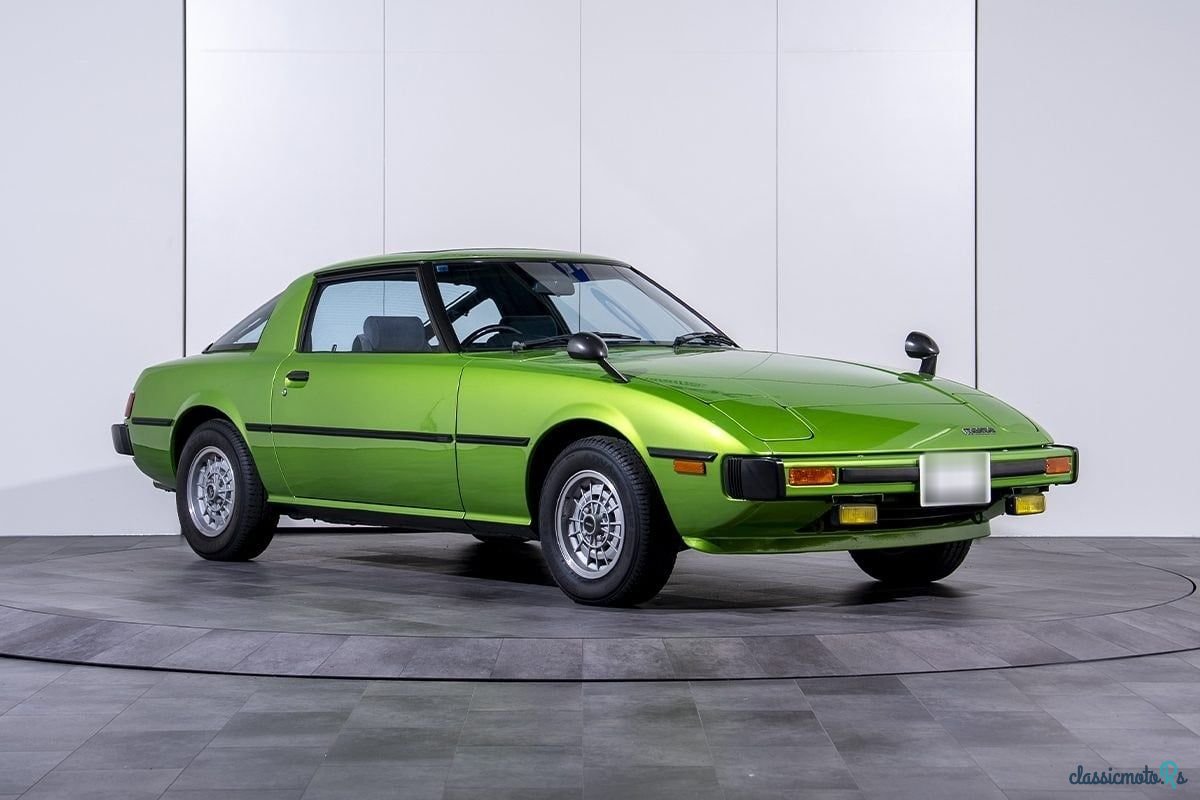
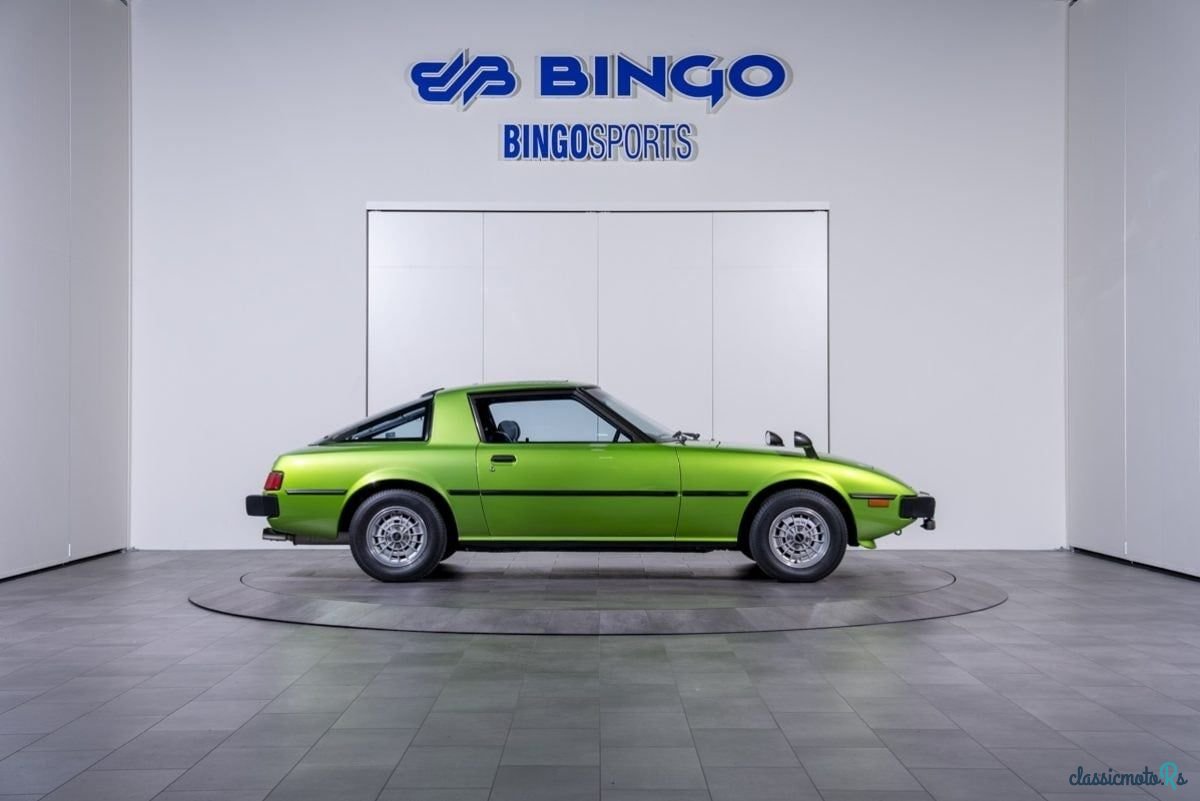
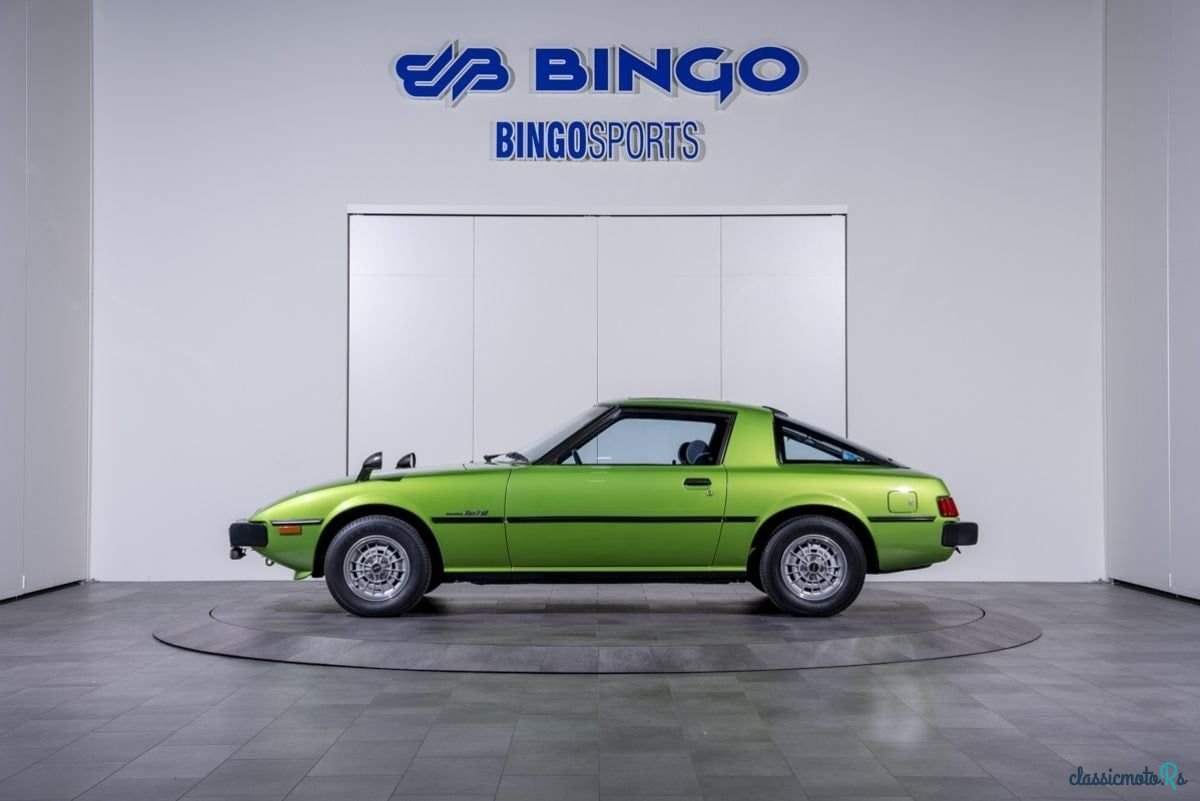
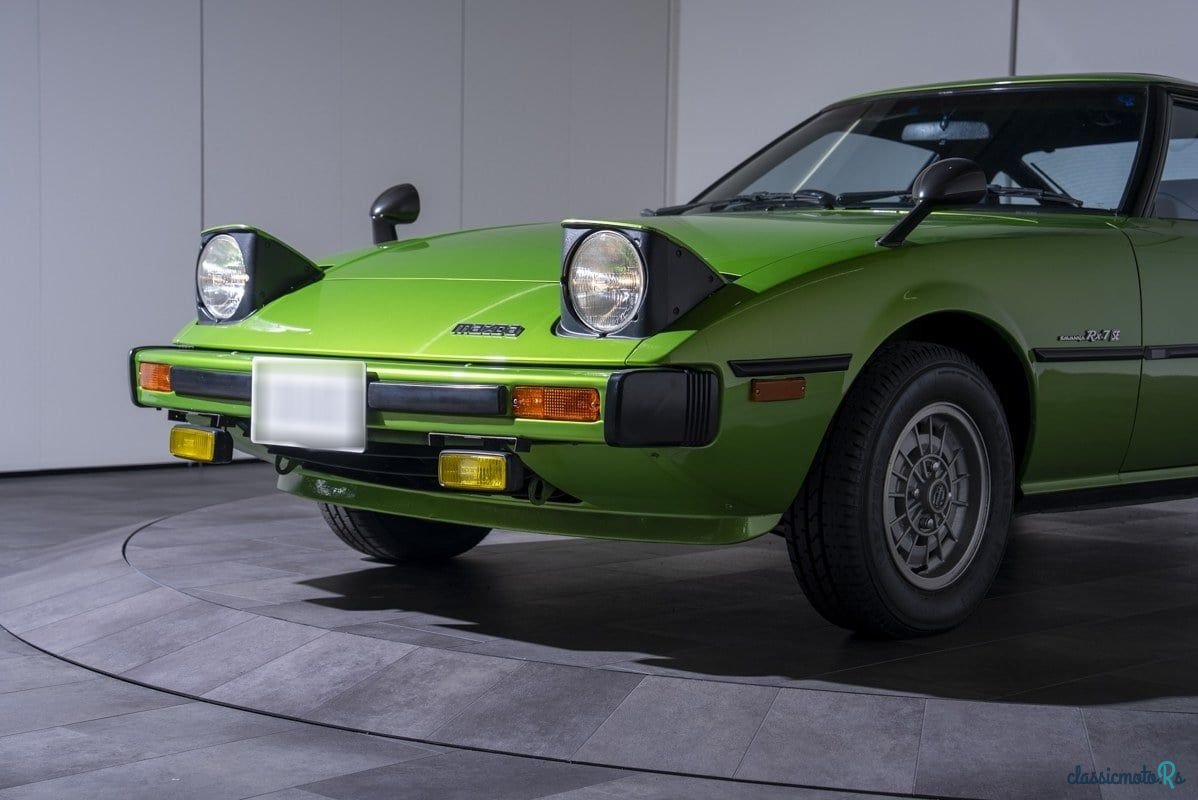
The design adopted retractable headlights, which can be said to be a symbol of sports cars, and the low bonnet and lowered nose created a refined (wedge-shaped) design with low air resistance.
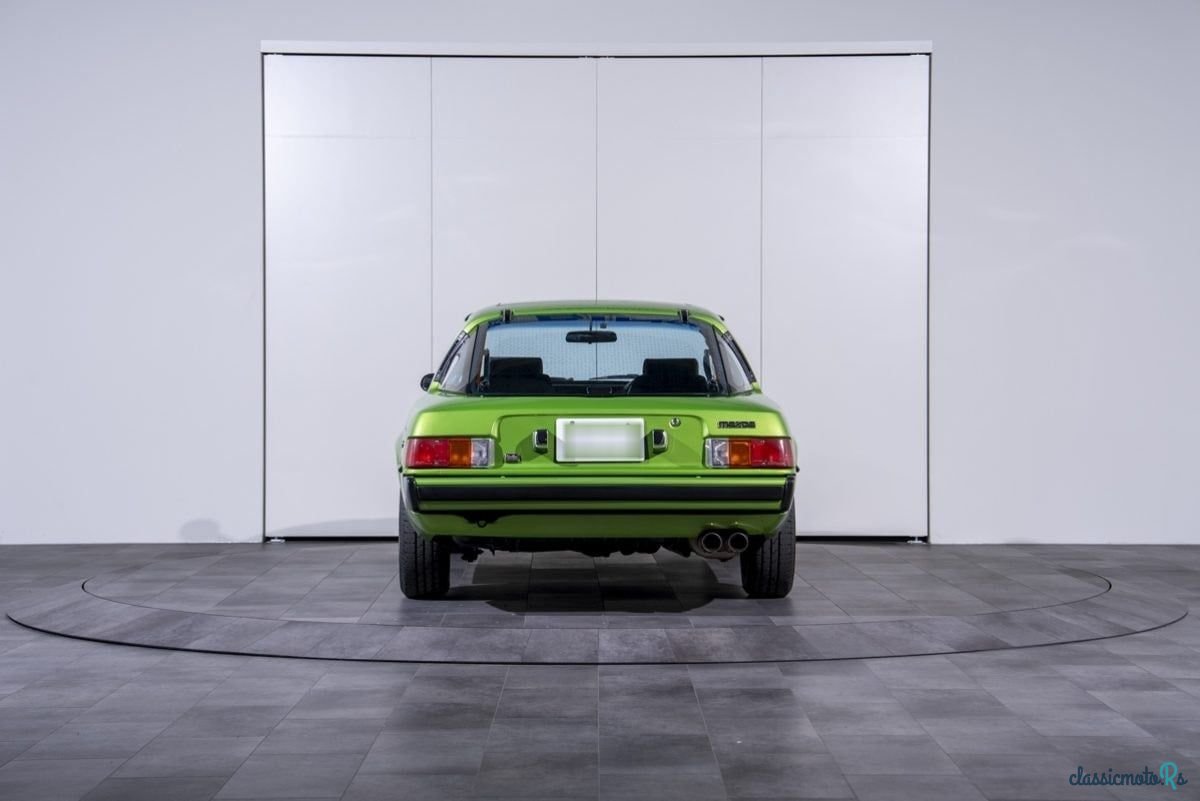
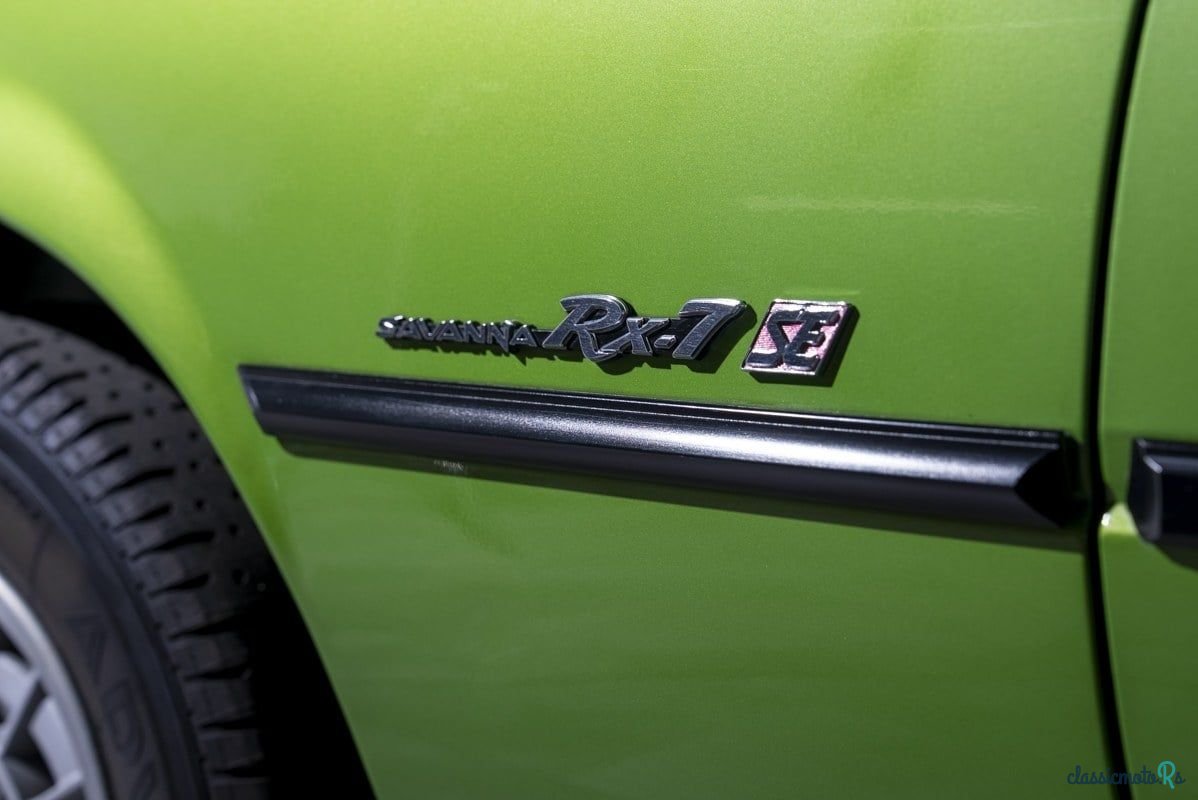
Of the five colors available, this particular car is in the image color Mach Green
. The metallic green paint further accentuates its presence.
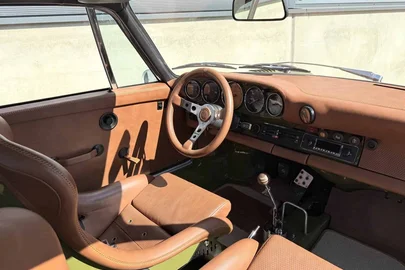
The interior also has a sporty feel, with an easy-to-read analog tachometer at the center of the instrument panel, and a 380mm diameter sports-type steering wheel.
The mileage is 49, 119km, and it is almost entirely original.
This vehicle, which has been kept in good condition and is dedicated to originality, is a testament to the previous owner's attention to detail. Although the trunk dampers are starting to weaken, they were deliberately left as original parts, as new genuine parts are no longer available today. The fact that it is in
its current condition is entirely thanks to the previous owner.
In 1979, at the Daytona 24-hour race held in the United States, despite being a newcomer, it won the GTU (Small Displacement GT Car) class with its overwhelming durability.
At the time, IMSA races were dominated by large-displacement V8 machines, but the small-displacement Savanna RX-7 fought for long periods with its strengths of
"lightweight, excellent weight balance, a rotary engine strong at high RPMs, and reliability,"
and continued to win in the GTU class.
Rotary engines often have a reputation for being prone to breakdowns, but the 13B and 12A models were surprisingly durable with proper maintenance.
The rotary engine, which vibrates little and is less prone to breakdowns even when running at high RPMs,
had the characteristic of being "able to run at full throttle for 24 hours."
The Savanna RX-7's success at Daytona is
considered the origin of Mazda's endurance racing culture, which later led to the Mazda 787B's Le Mans victory.
The SA22, FC3S, and FD3S continued to win across generations.
The RX-7 series as a whole
achieved over 100 victories in IMSA, a feat legendary in American motorsport history.
The 1979 model gained international acclaim, including a test drive by film actor Alain Delon.
Going back to 1973, the Middle East War led international oil companies to raise crude oil prices and restrict supply.
Automakers suffered from rampant inflation and soaring gasoline prices, while simultaneously
reducing horsepower to meet emission regulations.
Toyo Kogyo (now Mazda) faced strong criticism, being labeled as a "bad engine with poor fuel economy and pollution." Similar reputations spread in the US market, causing a significant drop in Mazda sales.
However, Toyo Kogyo did not give up on the rotary engine. The rotary engine was inherently more efficient and had less loss than a reciprocating engine.
With that confidence, the 12A engine was completed after meticulous improvements.
It achieved approximately 40% better fuel efficiency compared to the early 1975 model.
Due to its reduced pollution, it was collectively called "REAPS" (RE ANTI POLLUTION SYSTEM).
The only thing left to do was to dispel the negative image of rotary engines. Toyo Kogyo decided to release a new car, and in 1975, the "Cosmo AP" equipped with the 12A engine was born.
"AP" stood for low pollution and low fuel consumption.
The Savanna RX-7 was equipped with the same 12A engine, which was packed with Mazda's best efforts in technology.
The RX-7's 12A two-rotor engine boasted 130 PS and fully demonstrated the characteristics of a rotary engine.
Compared to reciprocating engines, it is overwhelmingly lighter and smaller, and despite being a front-engine car, its front-midship configuration, centered in the vehicle, achieved an ideal front-to-rear weight distribution of 50. 7:49. 3 even with two occupants.
The transmission was a 5-speed manual.
A 3-speed automatic was also available, but the manual transmission was highly favored from a sporty perspective.
The Savanna RX7, weighing only about 1000kg, had a suspension system with a strut type at the front and a 4-link rigid axle with a Watt link at the rear, utilizing know-how honed in racing to achieve a comfortable and enjoyable driving experience.
While many Japanese cars of the time had rigid axles, the RX7 was designed for sports cars.
The design adopted retractable headlights, which can be said to be a symbol of sports cars, and the low bonnet and lowered nose created a refined (wedge-shaped) design with low air resistance.
Of the five colors available, this particular car is in the image color Mach Green
. The metallic green paint further accentuates its presence.
The interior also has a sporty feel, with an easy-to-read analog tachometer at the center of the instrument panel, and a 380mm diameter sports-type steering wheel.
The mileage is 49, 119km, and it is almost entirely original.
This vehicle, which has been kept in good condition and is dedicated to originality, is a testament to the previous owner's attention to detail. Although the trunk dampers are starting to weaken, they were deliberately left as original parts, as new genuine parts are no longer available today. The fact that it is in
its current condition is entirely thanks to the previous owner.